



Labour is being replaced by forces to its left. But the party is dominated by right-wing factionalists whose entire political worldview is defined by hatred of the left. Indeed, that is essentially the only political vision they happen to have.
Now that the full results are in, we can make some definitive political conclusions.
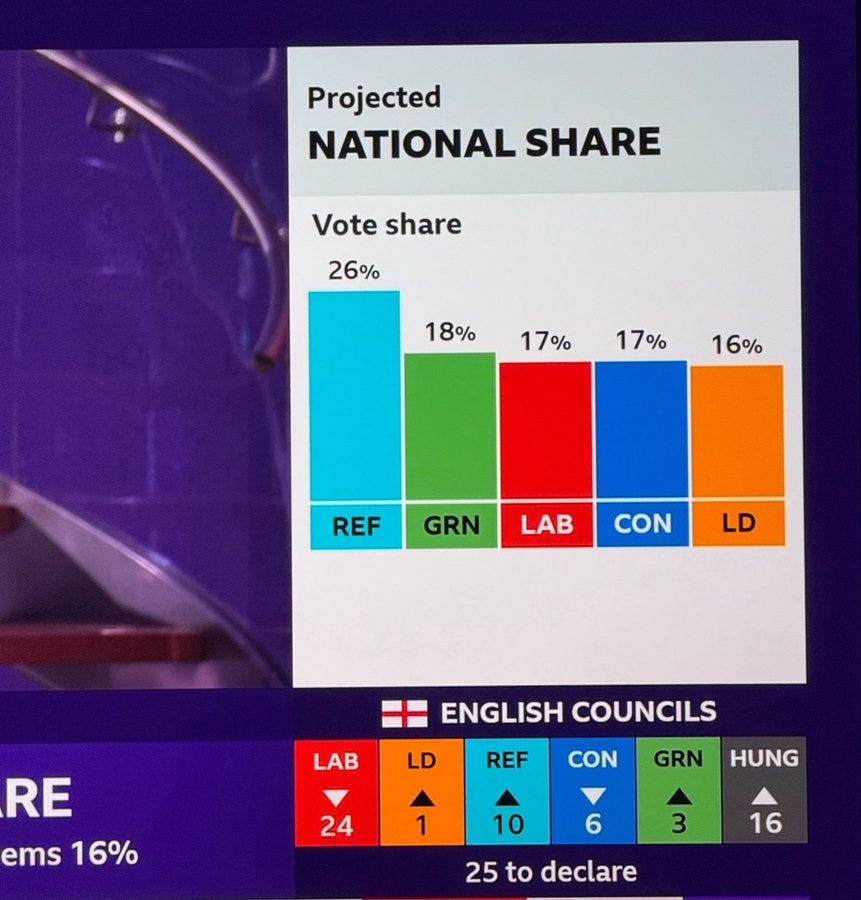
As expected, Reform came top, chalking up just over a quarter of the vote. That is, of course, grim - last week, the party essentially called for concentration camps for migrants and refugees to be opened up in communities that vote for their political opponents.
But their projected national vote share declined by 4 points compared to last year. The party has pivoted to loud-and-proud Thatcherite economics - this was after a flirtation with, for example, nationalising the water industry. And it has absorbed several former Tory Cabinet ministers. These may well be repelling some voters who are opposed to immigration, but who are economically speaking on the left.
Meanwhile, the Green Party came second with 18%, a 7-point increase compared to last year. That exceeded much of its current polling.
In Manchester - where only some seats were up for election - the Greens hoped to win at least 6 councillors: they won 18, bringing their total to 18. In Newcastle, they went from 4 seats to 24. In Sheffield, they went from 4 to 10. In Birmingham, their seats went from 2 to 19. Independent candidates rooted in Muslim communities opposed to Israel’s genocide also surged - although alas, many do not have a progressive inclination.
In Hastings and Norwich, the Greens won control of the councils altogether.
They won the popular vote in Manchester, Oxford, Norwich and Hastings.
In London, the Greens won historic victories.
In Hackney, Zoe Garb won the mayoralty with over 47.2 of the vote, a near 12-point lead over Labour. In the last 22 years, Labour have won every single contest - and their smallest ever victorious margin was 25 points.
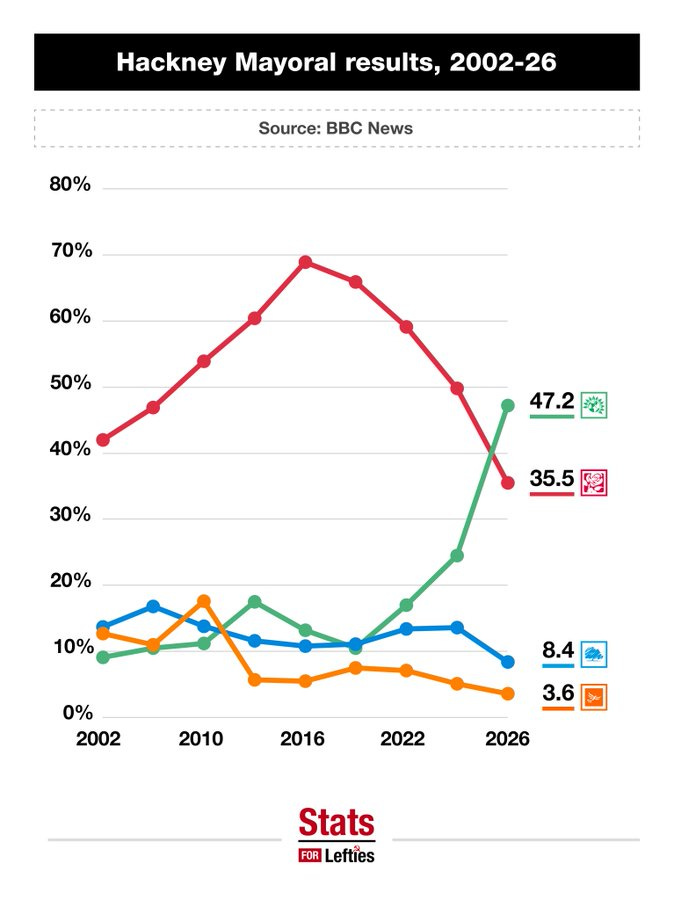
They stormed Hackney council, too, gaining 42 out of 57 seats. In the 2022 election, they had won just 2 seats.
The Greens won the Lewisham mayoralty - again, breaking uninterrupted Labour hegemony - and won the council there, too, winning 40 out of 54 seats. They didn’t win a single seat in 2022.
In Waltham Forest, they took the council with 31 out of 60 seats. Here, too, they didn’t win a single seat at the last election.
They also became the biggest party in Lambeth - where they went from 2 seats to 29 - and Haringey - where they won 28 seats, compared to none last time.
The pattern is clear: the Greens are displacing Labour across urban England.
If you look at the results through a parliamentary lens, then the Greens would have won 35 seats in a general election.
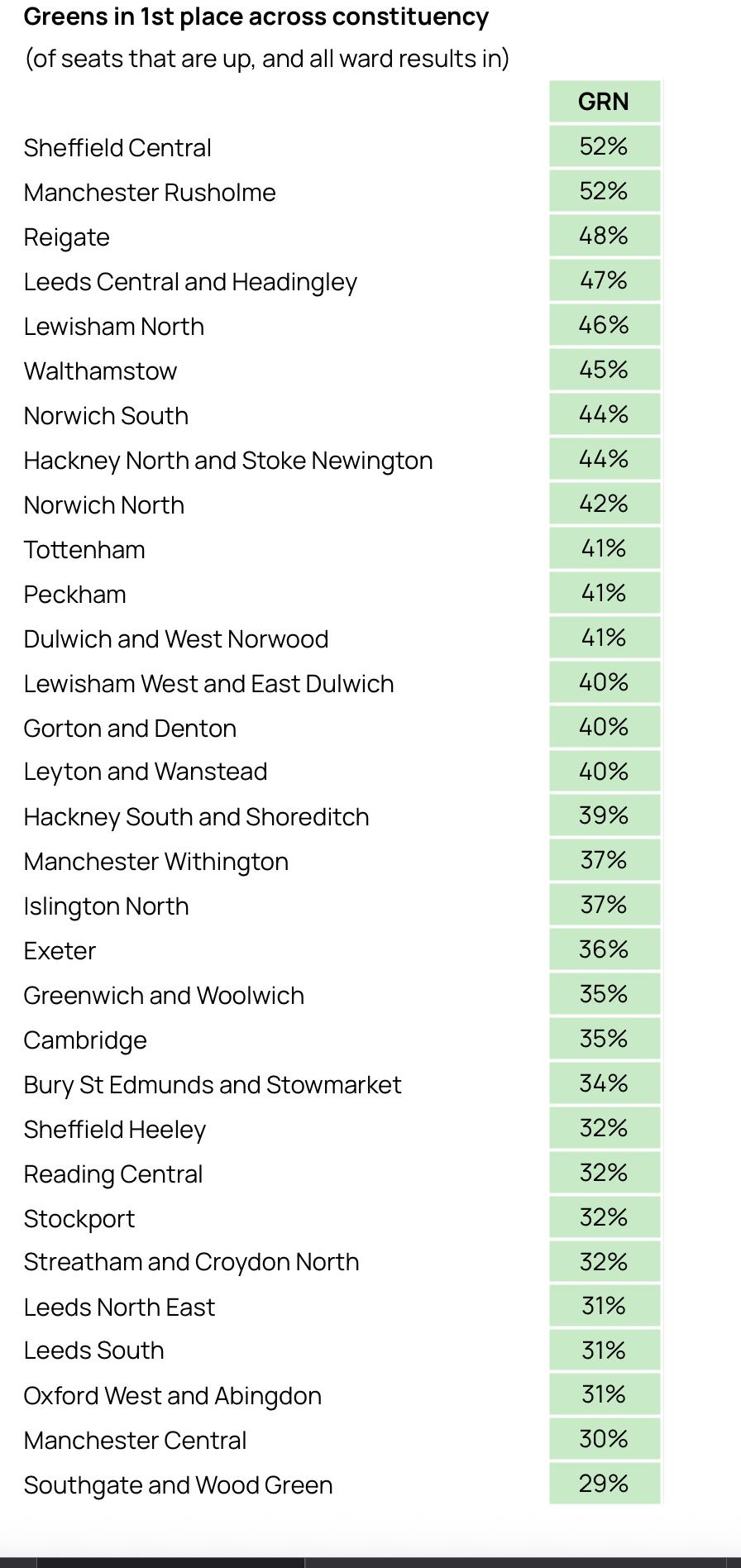
But the Greens should expect to do even better than that. Only some English local authorities held elections last week. That includes places where the Greens could be expected to win seats, like Bristol, Brighton (these two already have a Green MP each), Liverpool, Manchester (the parts which didn’t have an election) and Lancaster.
There’s another factor, too. Younger voters are even less likely to vote in local elections than in general elections - and they are the Greens’ strongest supporters. Conversely, that means older voters - who are most likely to vote Reform or Conservative - are even more overrepresented in local elections.
The Greens, therefore, could expect to do even better in a general election.
It’s also true that the Greens were on the receiving end of a vicious smear campaign. That certainly cost them votes - I know this having spoken to local activists across the country. But that factor isn’t going to go away - in fact, it’s only going to intensify. So they need a strategy to deal with that.
But as a blog by pollster YouGov’s Patrick English underlines, it is the Greens who pose the biggest challenge to Labour.
He writes:
During the overnight count in the small hours of Friday morning, John Curtice appeared on air to suggest that the ward level results suggested that Labour were losing out more to the Greens than they were to Reform. The evidence was quite clear on this when we looked at who was ‘suffering most’ when either the Greens or Reform were advancing strongest.
According to the data collected and analysed as part of the BBC’s Keyward exercise, Labour were dropping back on average by a whopping 37 percentage points in wards last contested in 2022 where the Greens were advancing most strongly in 2026 (up 30pts or more).
He goes on to say:
Conversely, Labour were down by much less than that, 20pts (which is still an awful lot, by the way), where Reform were up by 30pts or more versus 2022.
The relationship becomes even clearer when we look at the other side of the respective scales. Where the Greens were advancing least (by only up to 10-points or less), Labour were only down by an average of 12pts versus 2022. But they were still down by an average of 20pts where Reform were advancing by only up to 10% or under - making the relationship on that side of the coin completely flat.
Or, in other words, there is little to no statistical relationship between Reform performance and Labour performance, but a very strong (negative) relationship between Labour and Green performance.
It’s in areas where Labour previously had high vote shares where the Greens did best.
The evidence is overwhelming. The Greens are the most successful left-of-Labour party in history. It is replacing Labour in its urban heartlands. But Labour is led by ideologues who are fanatically opposed to the left.
Their understanding of politics is that the party must chase voters from a right-wing direction - by clamping down on immigration, or opposing progressive economic policies. Kicking out foreigners is a “legitimate concern”: wanting to hike taxes on rich people is not.
And what about Wales: Welsh Labour was the most electorally successful political party on earth, winning every national election since 1922. Yet here the party was wiped out, collapsing to just 11% of the vote. It was Plaid Cymru, Welsh nationalists with an unashamedly left-wing political orientation, who triumphed in the Senedd election. The Greens, too, won their first two seats.
But it’s not the Labour hierarchy who are in denial. The British media refuses to treat the left as legitimate political actors. The acceptable political universe has to span ‘centrist’ to extremely right-wing.
A compelling reason to change the media landscape in this country.
Zack needs to think quickly. I'm delighted Greens are the biggest party in Haringey. Greens need to work closely with LibDems now and for the general election to maximise representation in first past the post system. I feel the only places Labour won councillors was where Middle classes propped up the old regime. The are people who would support Labour even if they advocated gassing grannies.
Is there a source for the Projected National Vote data?