


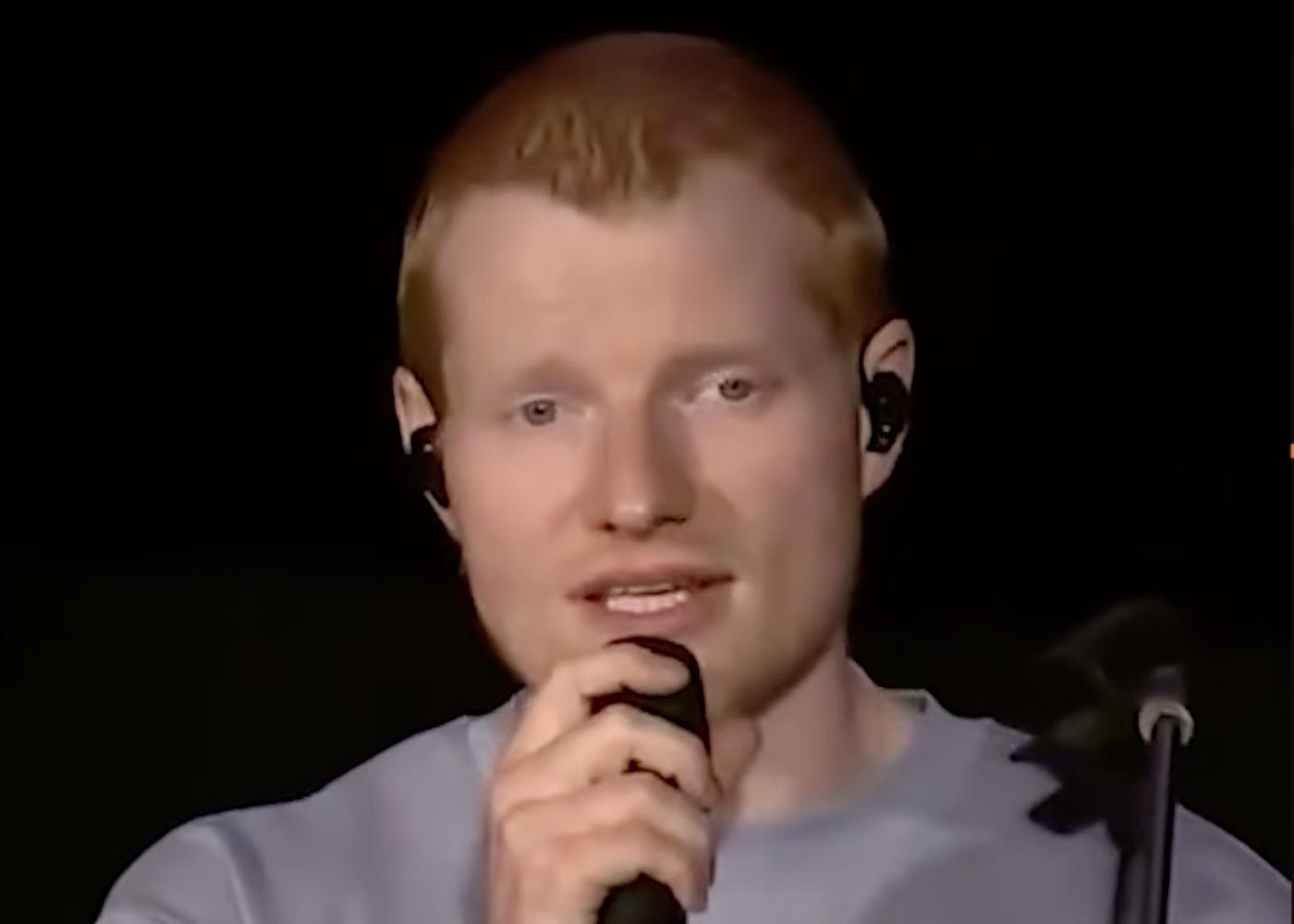
What words to describe Ed Sheeran’s so-called “apology” on stage in Philadelphia?
The word “travesty” doesn’t do it justice. A disasterclass, perhaps?
It comes after US rapper Macklemore was booted off his tour after saying “Free Palestine” and showing his solidarity with a Palestinian people suffering genocide and every war crime imaginable at the hands of an Israeli state which is armed and backed by the West.
This happened at the behest of billionaire stadium owners, not least Robert Kraft, a friend of Donald Trump and Benjamin Netanyahu who has donated vast sums to Israeli causes and has even been awarded a $1 million award for services to Israel.
As a result, Sheeran’s other support acts and even his backing band withdrew.
The disastrous speeches Ed Sheeran gave on stage in Philadelphia brought to mind the words of another bland pop artist, Ronan Keating: you say it best when you say nothing at all.
Sorry for what?
Sheeran began the concert by addressing the controversy directly.
“I’ve had to take and make difficult decisions,” he told the audience, saying that he was “making mistakes” and was “so, so sorry”.
But that immediately raises the most basic question: sorry for what?
He acknowledges making mistakes and apologises for them, but he doesn’t specify which decision was mistaken, whom he had wronged, or what he would do to repair it. There is no mention of Macklemore, his other support acts and backing band, or indeed Robert Kraft.
And there seems a rather striking contradiction with Sheeran’s previous written statement. Last week, he had insisted that “Macklemore coming off tour was the promoter’s decision, it was not mine”. Now he says that he has “had to take and make difficult decisions” and that he is “making mistakes”.
Which decisions?
If removing Macklemore was not one of his mistakes, what precisely is he apologising for? And if he does now believe Macklemore’s removal was wrong, why can’t he simply say so?
Is he apologising for failing to defend the humanity and rights of the Palestinian people? For his terrible first statement? Or is he simply sorry for disappointing people – which is the equivalent of saying “I am sorry that you are upset”, without actually apologising for the deeds themselves?
Does he think it was wrong to remove his longstanding friend and colleague Macklemore for speaking out about Palestine – which he knew in advance Macklemore would do – and does he think that should be reversed?
None of that is made clear.
To be fair, Sheeran does say he is “deeply worried” by the idea of venues pre-approving performers’ content, adding that this “should never happen in the free world”.
But this is weak, weak stuff in response to his support artist and friend being removed at the behest of a pro-Israel billionaire. He cannot manage a straightforward direct condemnation. What does “deeply worried mean in a practical sense? There is no call for Macklemore to be reinstated.
He does not say that what happened to him was wrong. He does not name Kraft. He carries on with the tour.
When does the story begin?
Then he makes another fundamental error: he treats 7th October as the beginning of the story.
This is exactly what the Israeli narrative wants: to erase decades of ethnic cleansing, apartheid, occupation, colonisation, torture, mass incarceration and slaughter inflicted on the Palestinian people.
He links October 7th to “centuries of Jewish pain” – but he offers no equivalent context or historical account for the Palestinian people.
Palestinian suffering appears as a terrible humanitarian crisis of the here and now, rather than in the context of generations of murderous oppression.
He said that he was speaking to people “across the spectrum” about helping victims, and was “listening and learning because I do not know enough”. You may think to yourself: there is nothing wrong with showing humility and acknowledging limits to your knowledge.
But there has been three years of a live streamed genocide. No genocide in history has been so evidenced as it happened, nor as confessed to by the perpetrators as it happened. There is more than enough information available for the most moderately engaged individual to conclude a heinous crime is being committed.
Why is he confident enough in his knowledge to place October 7th in the context of “centuries of Jewish pain”, but not when it comes to Palestinian suffering?
He says “what is happening in Gaza” is “catastrophic and unjustifiable and disproportionate”, but he fails to name who is responsible for the “what is happening in Gaza” he describes.
The role of Israel is completely erased.
Imagine someone saying “what is happening in Ukraine is catastrophic, unjustifiable and disproportionate”, without mentioning Russia.
Indeed, what does “disproportionate” mean exactly? How many Palestinian children would it have been acceptable to kill?
This reflects the widespread Western media narrative that has existed ever since Israel began to wipe Gaza from the face of the earth and butcher tens of thousands of people, including at least 20,000 children.
It has been portrayed as Israel exercising its “right to self-defence”, with a side debate about whether this “response” is “proportionate”, where we can all agree to disagree.
Israel has committed genocide, as per the consensus of genocide scholars, not least Israeli scholars of genocide and the Holocaust, a UN commission, and NGOs ranging from Amnesty International to Human Rights Watch.
A genocide is not “disproportionate”. It is the crime of crimes. There is no worse crime than genocide.
You don’t get to opt out of politics
Sheeran says he never wanted to be an activist.
But that doesn’t answer the criticism.
Nobody is demanding that every popstar has to become a political campaigner – though it is not unreasonable to want everyone with a platform to speak out about a genocide, the crime of crimes, which is being directly facilitated by Western nations.
The specific question here is different: would he defend a fellow performer’s ability to advocate freely for a Palestinian people suffering genocide at the hands of a Western ally, rather than allowing that performer to be silenced by billionaires?
This is someone Sheeran brought on tour knowing full well that Macklemore is a profoundly political artist, knowing full well that he was going to advocate for Palestinian freedom, and knowing that he has a signature song – Hind’s Hall – literally about this issue.
There is an obvious and important distinction between choosing not to turn your concerts into political rallies – which Macklemore did not do by making a few comments, not least while introducing his song about Palestine – and accepting political conditions imposed by billionaires who own the venues.
Doing the latter isn’t opting out of politics. It is allowing a particular form of political power to prevail.
And imagine exactly the same situation with Ukraine. Imagine a performer said “Free Ukraine” before introducing a song inspired by a Ukrainian child killed by the Russian army. Would anybody seriously claim they had turned the concert into a “political rally”? Of course not. If a venue tried to ban them from performing because of those remarks, the outrage would be immediate – and entirely justified.
There’s a straightforward explanation here. An expression of solidarity with a people suffering at the hands of an official enemy is treated as basic humanity.
Solidarity with Palestinians suffering at the hands of a Western ally, on the other hands, is treated as divisive, “political” and impossibly complicated.
Sheeran says he has tried not to be “a political commentator of any kind”. But his previous, entirely justified solidarity with Ukraine cuts across that claim, as does his expressed support for the Labour Party and opposition to Brexit, for example.
“The most complex political issue on the planet”
Then he calls the question of Israel and Palestine “the most complex political issue on the planet”.
This is a political crutch, and it is deeply infuriating, because it is always used to muddy the waters when it comes to horrific crimes.
Indeed, actual apologists for horrific crimes – and I’m not accusing Sheeran here of being one – always invoke this argument.
Take the Srebrenica massacre in 1995, classified by the UN as genocide.
Of course you can make the argument that the history surrounding it was complicated, and apologists for the Bosnian Serb army did exactly that.
Was this not rooted in centuries of complicated ethnic conflict? Did Serbs not suffer genocide at the hands of the Nazis’ Croatian collaborators during the Second World War? Were thousands of Bosnian Serb civilians not killed during the Bosnian war? Were Serbs not killed in villages around Srebrenica in the years before the massacre, as the Bosnian Serb nationalist argument went?
This is oh so complicated, it is not for outsiders to impose some simplistic black-and-white view – that was the claim.
But here’s the thing.
Injustices can often have deeply complicated histories. That doesn’t make the crimes themselves morally complicated.
International law is either abided by, or it is not.
And while the history leading up to a genocide may indeed be very complicated – as it was in Rwanda, or other genocides – whether a genocide is right or wrong is not complicated.
It is not complicated to say that Israel is subjecting the Palestinian people to an occupation which is illegal under international law, as per the International Court of Justice.
It is not complicated to say that wiping Gaza from the face of the earth is wrong.
Slaughtering innocent people is wrong.
Bombing hospitals is wrong.
Bombing schools is wrong.
Deliberately starving people is wrong.
We could go on.
A place where “everyone is welcome”
Sheeran talks of his concerts “still” being a place where “everyone is welcome” and where people can stand beside those with “opposing views”, while everyone enjoys songs of “love, hope and unity”.
I’m genuinely interested here: how far does he take that?
Is he saying he wants a concert where neo-Nazis are welcome, for example? I presume he draws some sort of line about what “everyone” means in practice?
Because otherwise this comes across as: look, whether you support slaughtering Palestinian children or oppose slaughtering Palestinian children, let’s agree to disagree, because everyone is welcome here!
But obviously, in any case, his concerts aren’t a place where everyone is welcome – because Macklemore got booted off his tour after pro-Israel billionaires intervened, did he not?
“I saw 50,000 people who haven’t abandoned me”
And then, later in the concert, Sheeran’s performance became even more grotesque.
Compare what followed with Macklemore’s own response to being kicked off the tour.
Macklemore deliberately centred the Palestinian people:
“I want to say something that should be obvious. In this moment I think it matters. I am not a victim. Ed Sheeran is not a victim. Pink is not a victim. We have careers, money, opportunities, safety and audiences around the world. Whatever consequences any of us face for what we say, we get to go home to our families. The victims are the Palestinian people.”
Ed Sheeran, alas, went in almost exactly the opposite direction.
Through tears, he told the crowd: “I really didn’t know whether I’d even be getting on stage again”, and questioned “whether I even want to be an artist at all”.
Then: “In these situations you really find out who your friends are.”
He talked about people he had known for years backing away and about feeling that his friends and family had abandoned him.
And then came his extraordinary statement: “I see 50,000 people who haven’t abandoned me.”
To choose such a framing is quite the choice.
Macklemore’s explicit point was: we are not the victims here.
Whatever personal or professional consequences immensely wealthy and famous musicians suffer, they return to lives of extraordinary privilege and security.
The victims are Palestinians being killed, starved and displaced.
Sheeran instead shifts the focus from whether his decisions were defensible to who had remained personally loyal to him.
And withdrawing from a tour on a principled basis – objecting to the censorship of an artist opposing genocide by billionaires – doesn’t mean ending a friendship.
Several of the musical acts emphasised their continued friendship with Ed Sheeran.
Friendship doesn’t mean you are obliged to suspend your conscience.
Indeed, what kind of friendship would that be? “If you want to remain my friend, you have to put your conscience to one side over a genocide”? That’s not friendship.
I’d also suggest Sheeran needs to ask himself some searching questions here, because he has accidentally admitted that he accepted the decision of a pro-Israel billionaire not just over his support acts and backing artists, not just over what is right, but over members of his own family.
Here’s another point.
Sheeran didn’t even say: I condemn what happened to Macklemore. It was wrong that he was excluded against my wishes because he spoke out about the Palestinian people, but I feel obliged to keep the tour going out of loyalty to you.
What does that tell us?
Let’s keep reminding ourselves that Sheeran’s original defence was that the decision was out of his hands. Well, if it really was out of his hands, then what prevents him from saying without any equivocation that the decision was wrong?
He could have stated: “I couldn’t stop this, but I condemn it”. He chose not to.
It probably tells us that even if he had, the likes of Robert Kraft could have cancelled his tour.
Who is actually unsafe?
Then Sheeran described how frightened he had been about taking the stage.
“This wasn’t the easy option tonight,” he said. He didn’t know whether he would be safe, whether his audience would be safe, whether things might be thrown at him or people might boo.
Yes, Ed, it really is awful when people feel unsafe, isn’t it.
You thought things might be thrown at you. Like what – drink bottles?
If you’re scared of that, maybe try to imagine the terror of Palestinians whose lives are defined by missiles and bombs being relentlessly thrown at them by Israel – armed and backed, of course, by the country in which he was performing, the United States.
And by the end of the concert, having begun with an apology, Sheeran suddenly was saying sorry for having opened the night by talking about it at all.
“The one thing that I would like to apologise for,” he told the audience, was “the first bit of the show where it wasn’t about music and I had to talk”.
He explained that there were children in the audience and families had not bought tickets to hear him talk about this.
So what was the point of the apology in the first place?
And yes, Ed: children.
Like Palestinian children – some of whom will be, or will have been, fans of your music.
Some of those children have been slaughtered.
Others have survived with their limbs blown off. Their grandparents, parents, brothers, sisters, uncles, aunts, cousins and nephews may have been slaughtered. Their homes have been destroyed. They are living in apocalyptic squalor thanks to a state armed and backed by the West.
This is cowardice piled on self-pity piled on amorality.
The truth is that people across the world – including in the West and in the United States – have turned decisively against Israel’s assault on Gaza.
As the author Omar El Akkad put it:
“One day, when it’s safe, when there’s no personal downside to calling a thing what it is, when it’s too late to hold anyone accountable, everyone will always have been against this.”
History will remember those who spoke out against this abomination despite the costs involved.
And history will remember those who stayed silent because they feared those costs.
You can order my new book The Fall of the West: How They Really Lost It here.
I'd already turned my back on Ed in 2023 due to his lack of stance, same as his great friend Taylor. After last week, I rechecked all my streaming blocks against him were still in place. He cannot claim to be apolotocal any longer. Nor ignorant. You dont get such a stage to be silent or peddle complicity without repercussions. As always, Macklemore remains on my playlists, loudly.
Totally agree with you. He's not reading the room. There's no 'no politics', no neutral, no middle ground, when it comes to Genocide. You call it out. Or you're condoning it. It's that simple, Mr Sheeran