


London! If you’re around tonight, come see me in conversation with Ash Sarkar. Tickets here
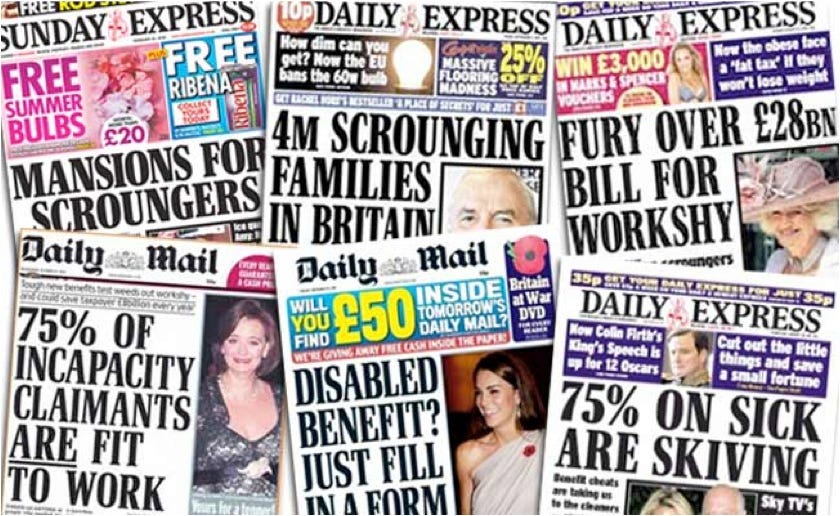
The right-wing media routinely lies, distorts and misleads its readers.
Rather than being means to inform and educate their readers - in theory, a crucial duty in a democracy - such outlets should be understood as nakedly political projects.
They are owned by wealthy moguls who defend a status quo fom which they profit.
They redirect people’s anger from the super-rich, like themselves, to people who are struggling: to benefit claimants, migrants, refugees, Muslims, trans people, to other minorities.
At the same time, they demonise even modest attempts to address the inequities of a status quo rigged in favour of wealthy vested interests.
With that in mind, here are four striking examples from the last week or so.
1. Benefit fraud nonsense
Let’s start with The Sun newspaper. The headline is ‘SNOOP-U-TURN Plan to spy on benefit cheats’ bank accounts SCRAPPED by Chancellor in blow to taxpayer’.
It goes on to say: “Benefit fraud currently costs the Treasury nearly £10bn a year.” This is false.
The DWP’s official estimate of fraud is £6.8bn for 2025–26. The £9.9bn total that matches the Sun’s claim includes mistakes made by officials or by claimants. Calling all of that fraud adds £3.1bn – which isn’t fraud, and isn’t claimed by officials to be fraud – to the figure. That inflates the amount of fraud by about 46% from the actual official figure.
Even the fraud figure is a statistical estimate, rather than a total established through criminal convictions. According to the Department for Work and Pensions, “a suspicion or evidence of intent is sufficient for statistical classification”.
Meanwhile, the National Audit Office reports DWP’s estimate that claimants received £4.9bn less than they were potentially eligible for in 2025–26: £1.2bn in official underpayments and £3.7bn in “unfulfilled eligibility”. That latter category includes people who could have received more had the information needed to establish a larger award been supplied.
That is equivalent to about 72% of the official fraud estimate. Keep that in mind when fraud is used to justify an onslaught against the welfare state.
And there’s another telling fact – according to the DWP, up to £12.7bn in Universal Credit or equivalent benefits went unclaimed in 2024–25. Where is the comparable outrage about people missing out on support?
2. Counting children and pensioners as working-age adults
Let’s stay on the topic of the welfare state and look at another false claim promoted by the Sun and the Daily Mail. They’re reporting on the plan by the Tory leader Kemi Badenoch to slash £36bn from benefits.
The Sun says: “The Tory leader wants to make big inroads into the £180billion a year going to working-age adults.”
The Mail says: “In a landmark speech on Tuesday, the Tory leader will highlight the latest official figures showing that working age welfare now costs the country £180 billion a year.”
The problem is what is being counted as “working-age”.
A Press Association fact-check examined the closely related £183bn claim made by Conservative deputy leader Alex Burghart and shadow work and pensions secretary Helen Whately.
So where did that £183bn figure come from? The Press Association suggests the Tories arrived at it by taking the Office for Budget Responsibility’s welfare forecast and subtracting whatever is officially labelled “pensioner spending”.
Except that doesn’t include all benefits paid to pensioners. Disability benefits received by pensioners are still counted, for example. So are Child Benefit and disability benefits for children. None of which makes someone a working-age adult.
Take those out, as PA did, and you get around £146bn for 2026–27. That’s £37bn less than the Tories claimed – more than the entire £36bn Badenoch says she wants to cut.
And even that £146bn isn’t exclusively spending on working-age adults. It still includes Northern Ireland’s social security spending, which hasn’t been separated by age in the forecast, as well as benefits that some pensioners can receive, like Universal Credit paid to couples where one partner is over pension age.
Indeed, rather than the working-age benefits bill ballooning, most welfare spending goes on pensioners - as you would expect.
Since 2010, pensioners have accounted for 82% of the real terms increase in welfare spending.
And other than in specific crises - such as the financial crash and the pandemic - overall spending on the welfare state as a percentage of GDP had remained very stable. It is 10.4% now - compared to 10.3% in 1994.
And we spend 4.8% of our GDP on benefits for working age adults and children - the exact same percentage as ten years ago, and almost exactly the same as in 1985, when it was 4.7%.
3. Inventing a better deal for Muslim students
Now turn to the Telegraph’s coverage of student finance, challenged by the Centre for Media Monitoring.
Its headline originally read: “British universities advertise ‘interest-free’ sharia loans to Muslim students”.
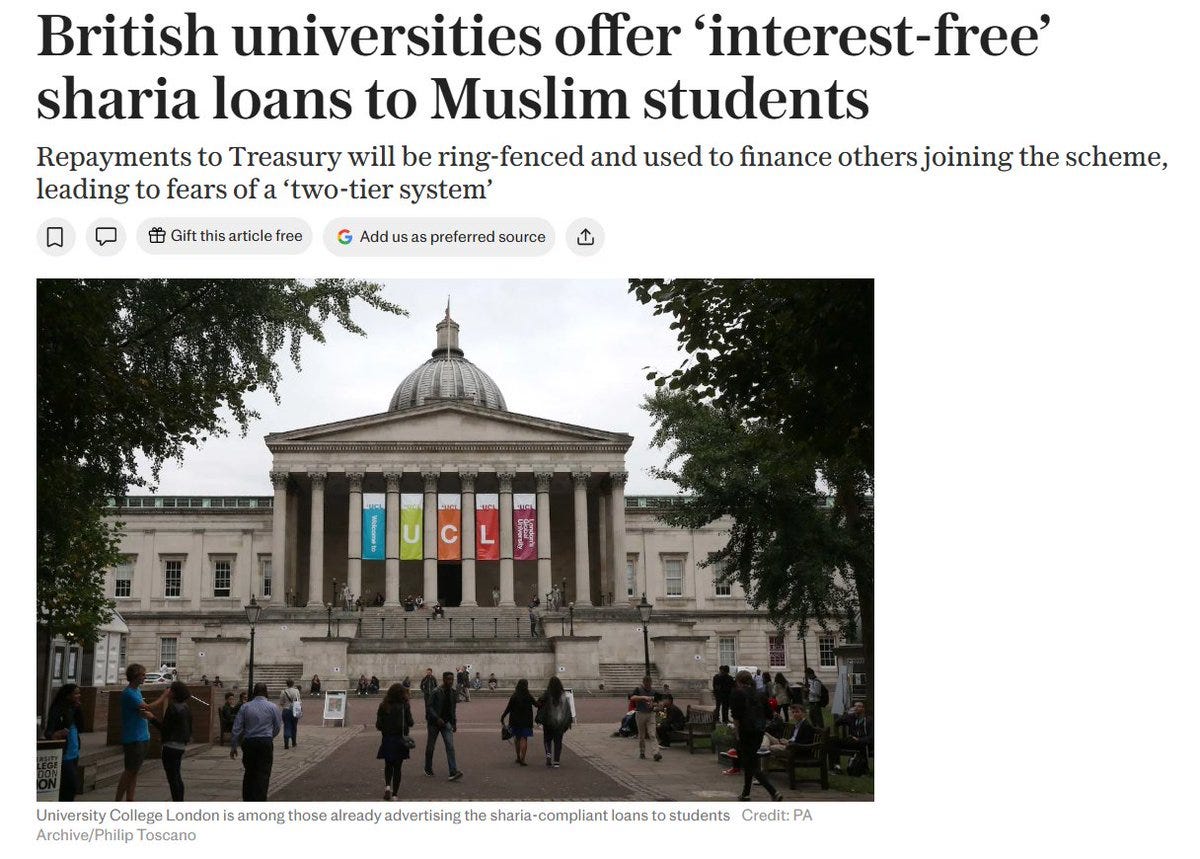
It quoted Suella Braverman calling the scheme “anti-British” and saying it “creates a two-tier education system”.
Reading this coverage you would think that Muslim students are getting a special deal that everyone else is denied. But the government’s own guidance disproves all of that. The proposed scheme is open to anyone who qualifies for student finance, regardless of their religion. They get the same financial support and pay back the same amounts, on the same timetable. And those repayments go towards supporting other students using the scheme – Muslim or not.
The Centre for Media Monitoring challenged the Telegraph over its coverage, and says the paper amended its headline and parts of the article. The version now available does acknowledge that the scheme is open to everyone and that repayments are equivalent. But that hasn’t stopped the suggestion that Muslim students are getting preferential treatment from spreading.
GB News published an opinion piece headlined: “Offering Muslim faith students a better deal than non-Muslims is deeply unfair and wrong”.
What better deal? The published policy explicitly rules one out.
4. Turning court claims into completed evictions
Then there’s the government’s modest but still welcome reform of the private rental market. The Renters’ Rights Act 2025 abolished Section 21 no-fault evictions and fixed-term assured tenancies in England from 1 May. It restricts rent increases to once a year, bans bidding wars and discrimination against families and benefit recipients, limits upfront rent, and strengthens tenants’ rights to request a pet.
The Times headline: ‘Evictions soar by 21% as rental reforms hit landlords’.
The Telegraph headline: ‘Labour admits rent reforms led to surge in evictions’, with a subheading claiming that evictions rose 11%.
The Times attributed 28,249 possession claims in England and Wales between July and September to private landlords.
This figure in The Times is false. Of those 28,249 possession claims, 8,802 were brought by social landlords – not private landlords, as the newspaper claimed.
But there’s a more fundamental problem. A landlord starting court proceedings is not the same thing as someone who is actually being evicted. The Times even acknowledges this distinction in the article itself, but then goes ahead and calls them “evictions” in the headline.
The Telegraph does something similar, because its 11% rise refers to possession orders, not to completed evictions. These are different stages of the legal process, but you wouldn’t know that from the headlines.
Actual repossessions carried out by county court bailiffs were down by 10% – a fall the Telegraph’s own report acknowledges, albeit near the end. That doesn’t tell us everything: not everyone forced to leave ends up being removed by bailiffs, and court proceedings can take months.
But there’s a pretty important detail in the figures. Accelerated possession claims shot up by 68%. These are closely associated with Section 21, the no-fault eviction procedure. New Section 21 notices were banned from 1 May, and landlords with valid notices already served generally had until 31 July to start proceedings.
So what we’re probably seeing is landlords rushing to use the old system before the deadline. Indeed, the Ministry of Justice's own statisticians say the surge in accelerated claims is likely linked to the transition to the new system. That’s rather different from the impression given by these headlines – that granting tenants more rights has caused evictions to soar.
We deserve better
The right-wing media want us to believe that benefit claimants are cheats, that Muslims enjoy special privileges, that modest social reforms lead to disaster and hurt the people they’re supposed to help.
All of this is because they are not driven by a desire to to inform and educate the public. They have a political project - to defend the wealthy and the powerful. That influences everything they say and do. The victims are democracy - and the wellbeing of the majority.
Oh for a constitutional rule that all political and media communications, at all times, be "fair, clear, and not misleading". Words straight out of the Financial Conduct Authority's rulebook for advertising. See the first-draft constitution in my book Reinvetning Democracy