



A historic by-election beckons, so I was in Gorton and Denton filming this weekend - and I’d love to hear what you think about our documentary.
I’ve got some other thoughts, too (and also I’ll be in Manchester on Sunday for the campaign’s last push - please do join us!)
A woman we spoke to in Denton raised an objection to undocumented migrants, and then said she was minded to vote Green.
Her voting intention was somewhat surprising because she made immigration a priority issue.
But to succeed, the Greens are going to attract significant numbers of people who have similar views on immigration to her. It comes back to what I think is the most important chart in British politics.
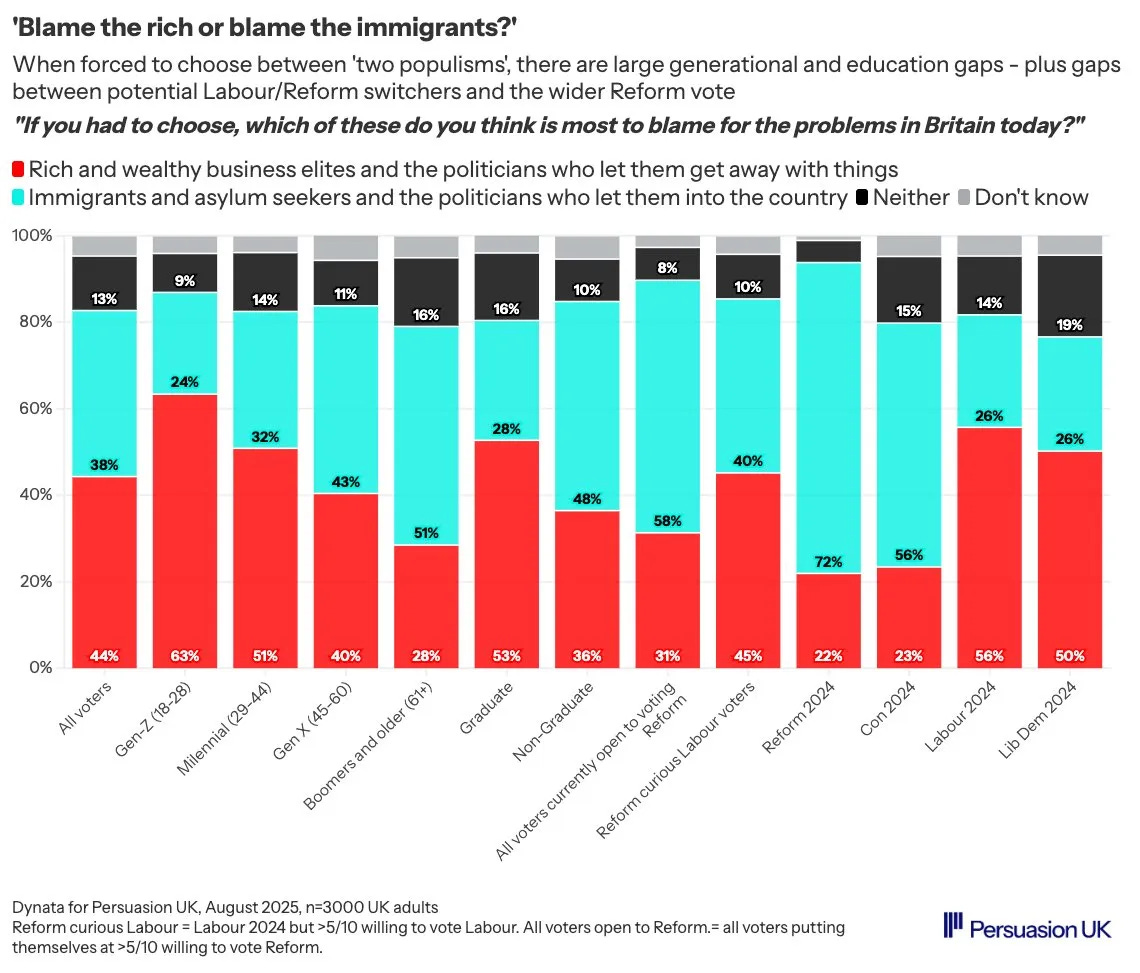
The population is divided between those who believe our problems are mostly called by rich and wealthy elites and their political allies, or migrants and asylum seekers and politicians blamed for allowing them to enter Britain. (A cause for the hope is that the former outnumber the latter).
A significant number of voters who primarily - correctly - blame the elites for the state of the country have objections to immigration.
Of course it is important to try and drive back the vicious anti-migrant scapegoating that defines British politics. Starmerism has indulged this phenomenon because it is opposed to challenging elites - partly for ideological reasons, partly because of who has funded it and showered its leading lights with freebies, partly because its politicians have one eye on future lucrative private sector jobs.
In doing so, it has helped doom itself - because Labour has just made immigration more of a salient issue. When it dominates the political conversation, that is almost always to the benefit of the right, as the experience of multiple European countries shows.
Of course the left needs to try and drive back vicious anti-migrant scapegoating - not least by humanising migrants and refugees.
But the most effective strategy is a laser like focus on holding elites accountable - and linking an improvement in living standards to redistributing wealth and power. The Mamdani strategy, if you will.
We met this Green voting woman in Denton, the older, less diverse part of the constituency which is deemed to be Reform’s heartland. And we undoubtedly met former Labour voters defecting to Nigel Farage’s party. It was depressing to put to one such voter the number of Tory ministers who have defected to Reform - and it didn’t bother him one bit.
But then we also met another lifelong Labour voter - an older working-class Mancunian who again many would stereotype as likely to opt for Reform over the Greens. But he was minded to vote for the Green Party’s Hannah Spencer, the local plumber who has become something of a political star.
I was deeply impressed talking to her. She’s unbelievably Manc - with the certain type of friendliness and humour that comes with it - as well as super smart and savvy. As much as the left rightly emphasises collective struggle, leaders do matter. She has a strong sense of class politics and a belief that, to succeed as a politician, she must be embedded in her community.
The Greens have assembled a very impressive grassroots campaign. They’ve got hundreds of activists knocking on doors, and I’ve rarely seen so many posters and garden stakes for a political party.
But we shouldn’t underestimate the online campaigning of the British hard right. There’s eight days to go, and the stakes are very high indeed. If Reform win, then Nigel Farage’s band of extremists will be a step closer to power. If the Greens win, then Labour face being replaced in their urban heartlands, losing the argument of ‘vote for us, or you’ll get Farage’.
I’ll share more thoughts when I go up on Sunday - but please do join us!
Please God, let the Greens win.
Farage and Reform are the closest thing you could get to the revolting Tory and Labour parties. He admires what Trump has done, and wants the same here, (citizens of the usa having been killed)! The Green party on the other hand, see the real problem - the ‘elites’ and the establishment. I would have thought that the revelations of the Epstein files, would have shown ‘ordinary’ people just how depraved, cold, and inhuman they are.
In addition it has now been confirmed that, despite the endless comments about Pakistani grooming gangs, networks of white grooming gangs all over London and elsewhere, are much more extensive. These involve politicians, judges, police, and many, many others.
If Labour had charged the ‘elites’ more tax, the NHS would by now have been restored to its best. This country also needs refugees and migrants for the taxes they contribute, and the skills they bring. The propaganda that says that these people are showered with benefits on their arrival, is untrue. What is true, is that with an elderly population, and falling birthrate, the UK needs the taxes paid by migrants in order to cover the running costs of the country - including the payment of pensions etc.
When Brexit took place, a lot of European people went back to their original countries, taking their skills and money with them. We are now desperate for both to be replaced by migrants and refugees.
Were Reform to win the next election, we could expect an authoritarian system, with the removal of our freedom of speech, and our right to protest. They would stick with the usa/israel, so there would be more and more wars. The zionist israeli influence over this country would continue, and widen. Refugees and migrants would be thrown out, which would lead to a reduction in taxes paid by them, followed by the resultant increase in taxes for the rest of us. The number of skilled people would also fall substantially, leading to fewer doctors to plumbers…..The NHS would suffer catastrophically, and the price of everything from house removals to plumbing jobs would go up. The choice of restaurants would also plummet.