


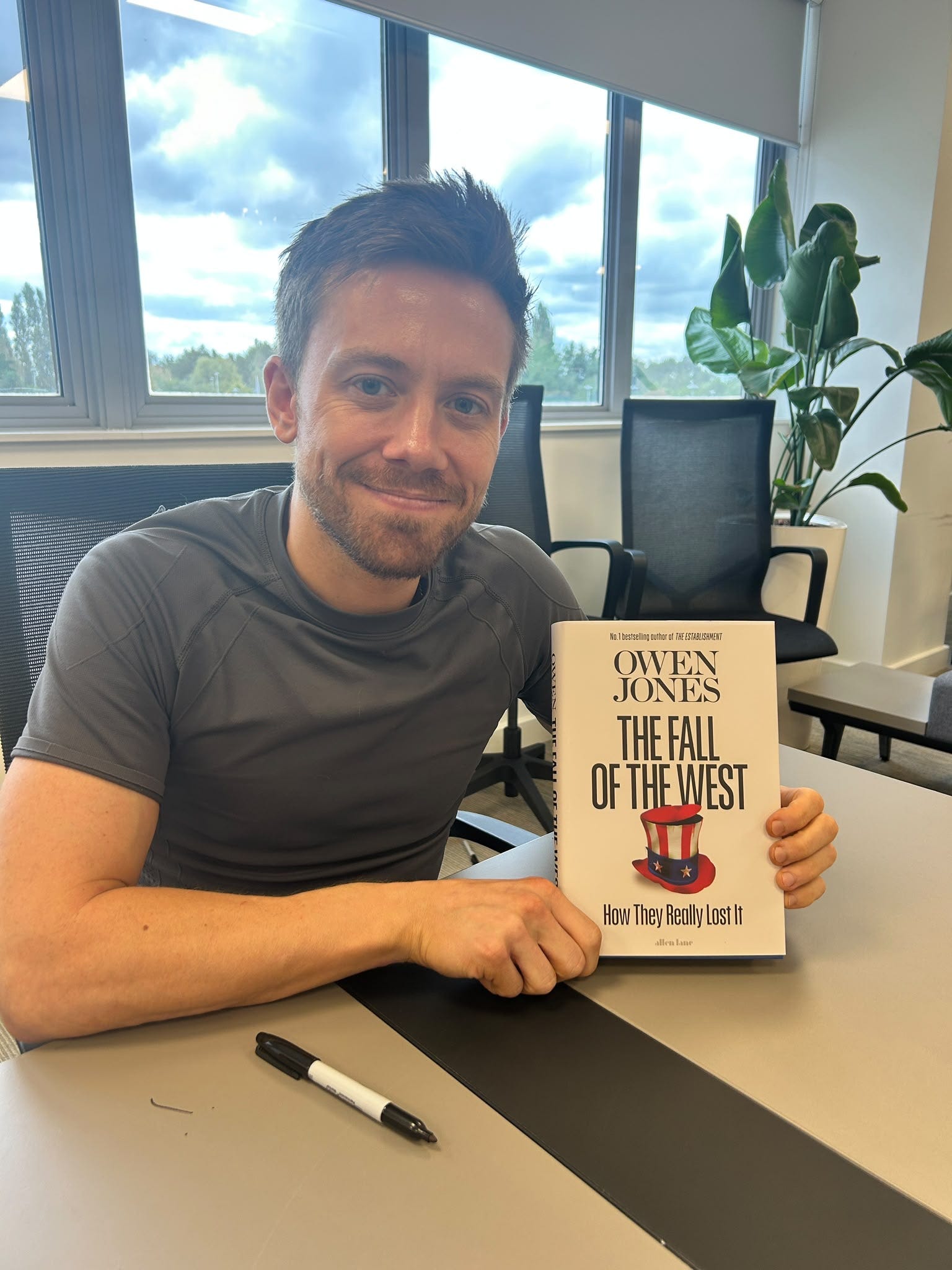
Below is my preface to my new book The Fall of the West: How They Really Lost It. you can get a copy here.
I’ve also included a sneak preview of the new book video. Let me know your thoughts!
Who holds power? How do they wield it, why, and to whose benefit? And when they fail, who is made to pay?
These questions have driven my writing from the beginning.
My first book, Chavs, looked at how working-class people suffered the costs of the Thatcherite economic experiment and, amid the wreckage, were mocked and demonized. My second book, The Establishment, turned to the perpetrators: a venal, self-insulating elite that rigged Britain’s political and economic order in its own interests, then escaped the consequences when that order began to fall apart.
This book tells a story of Western greed, power and hubris. It explores how the West has been sent into a tailspin by the elites who, some thirty-five years ago, once proclaimed its final triumph, and how their failure has today produced a global crisis. This crisis now affects us all, from those who live beyond the West’s increasingly militarized borders to its own citizens. Reporting it took me from Baghdad to Pittsburgh, Athens to Ramallah. Everywhere, I found a pattern that I had first encountered at home: elites whose decisions are driven by their own naked self-interest, and who protect themselves from the disastrous consequences of their own actions, presenting the world with the bill.
We are encouraged to treat domestic and foreign policy as separate worlds. Factory closures, stagnating wages and decaying public services belong to one story; events in Afghanistan, Iraq, Russia, Palestine and the collapse of Western moral authority to another. But in fact, and as this book shows, they are not separate stories. The order that sucked wealth upwards at home imposed itself through brute force abroad. Distant wars came home as squandered resources, shattered legitimacy, repressive powers – and people displaced by violence, then demonized as the source of insecurity.
If we want to truly understand our crisis-ridden present, we need to pay attention to our history. Because while we might think that the likes of Donald Trump, Nigel Farage and Marine Le Pen are deviations from the political norm, if we look at the attitudes and actions of Western elites over time – and especially, as I argue here, since the collapse of the USSR in 1991 – we’ll see that there is nothing new under the sun. There is, rather, a through line of extreme ideas, normalized by the elites who have imposed them on us. Seen in this light, these figures are not aberrations: they are, to adopt a phrase from another deeply unstable age, morbid symptoms of an order in decline.
Which is why, in this book, I explore a number of flashpoints: from the West’s disastrous hubris of 1991 onward, when it truly believed it could rule the world, through the catastrophes of Afghanistan and Iraq, the financial crash of 2008 and the turbulent decades that followed, as the West’s rulers sought to impose the same economic model on their citizens again and again while expecting different results. The answer to every failure was more of what had failed. Throughout, as we’ll see, those same elites have forgotten their own ruinous history – or have deliberately chosen to ignore it, in the hope that we will do the same.
The idea that the West is in decline is fundamental to the political right. It blames the West’s ills on migrants, Muslims, refugees, trans people, and anyone else who can be cast as ‘other’. This narrative, which today infuses the discourse of Western politicians and the media, is a lie. And yet, the West’s decline is real – we feel it in our everyday lives – and there is no reason to expect it to be orderly or painless. We deserve to understand what truly caused it.
I wrote this book, then, to expose the greatest political con of our age. A deliberately inequitable, extractive economic model that stripped millions of security and comfort at home while unleashing blood and chaos abroad, foisted on us as established, unalterable fact, has brought the West and the wider world to crisis. What’s more, it has done this in a remarkably short period of time: a little under half a century. Yet our political and media classes have laboured to make this truth unsayable. Pointing to the wound, they protect those who inflicted it, along with the system that explicitly promises wealth and power to the few at the expense of the many. Having inflicted such extraordinary damage on the world and their own societies, those who rule the West have weaponized the resulting fear and fury to tighten their grip.
Much of what follows is bleak, because we have to confront the world as it is. But despair is not my intended conclusion. Humanity is capable of astonishing invention, creativity, solidarity and love, much of which has been suppressed by a political and economic order that has brought us to the edge. Only by understanding how we arrived here can we begin to imagine another, better future.
Really looking forward to this book and can’t wait to get stuck in. Thank you, Owen for helping to keep me sane in a world gone mad.
Owen, I think I’ve spent the last few years writing adjacent versions of the same essay you keep writing, which is either a sign of intellectual convergence or a very niche form of collective madness.
I share a great deal of your diagnosis. The scapegoating, the hollowing out, the obscene concentration of wealth and power, the way people who have been failed materially are encouraged to direct their anger at migrants, minorities, the poor, anyone except the people and structures actually making the decisions — all of that feels deeply familiar to me.
But strangely, even in the middle of that sadness, I don’t feel entirely hopeless.
Part of the reason is people like you. There are still people in the West who believe that human dignity is not conditional — not on income, nationality, usefulness, respectability, or whether someone happens to be politically convenient. The dignity of working people matters. The dignity of migrants matters. The dignity of marginalized people matters. The dignity of the person everyone has decided to blame this week matters.
And you have defended those people consistently, often when it would have been much easier not to.
I write a lot about decline, and one thing I keep coming back to is how easily we confuse decline with apocalypse. Apocalypse is oddly comforting. It gives us a dramatic ending and, perhaps more importantly, lets us imagine ourselves as the exceptionally cursed generation standing at the end of history. Very flattering, really.
But decline is much more ordinary than that. Empires decline. Political orders exhaust themselves. Institutions decay. New equilibria emerge. History is absolutely littered with civilizations convinced they were uniquely doomed.
The question is not simply whether the West declines. It is what comes out of that decline.
And I still think there is enormous possibility here: new forms of solidarity, new ways of organizing economic life, new institutions, a less imperial relationship with the rest of the world, and perhaps even the radical discovery that a society does not have to humiliate its own working class in order to function.
Where I particularly value your work is that my own instinct is usually to climb to 30,000 feet and start muttering about empire, civilization, technology, dignity and the moral architecture of modernity — which is all very enjoyable until someone reasonably asks, “Yes, but what actually happened?”
That’s where journalists like you matter.
You go back down into the documents, the numbers, the individual cases, the policy decisions, the contradictions. You do the patient work of establishing what is actually true. And that makes the larger argument infinitely stronger.
So I think we are often looking at the same landscape from different altitudes. I’m usually staring at the weather system. You are also checking who left the window open.
I’m very grateful for that.
And for whatever it’s worth, I think there is still light in the middle of all this — not because decline isn’t real, but because human beings are still capable of solidarity, invention, courage, humor and love.
That seems like a reasonably good set of raw materials to begin again with.