


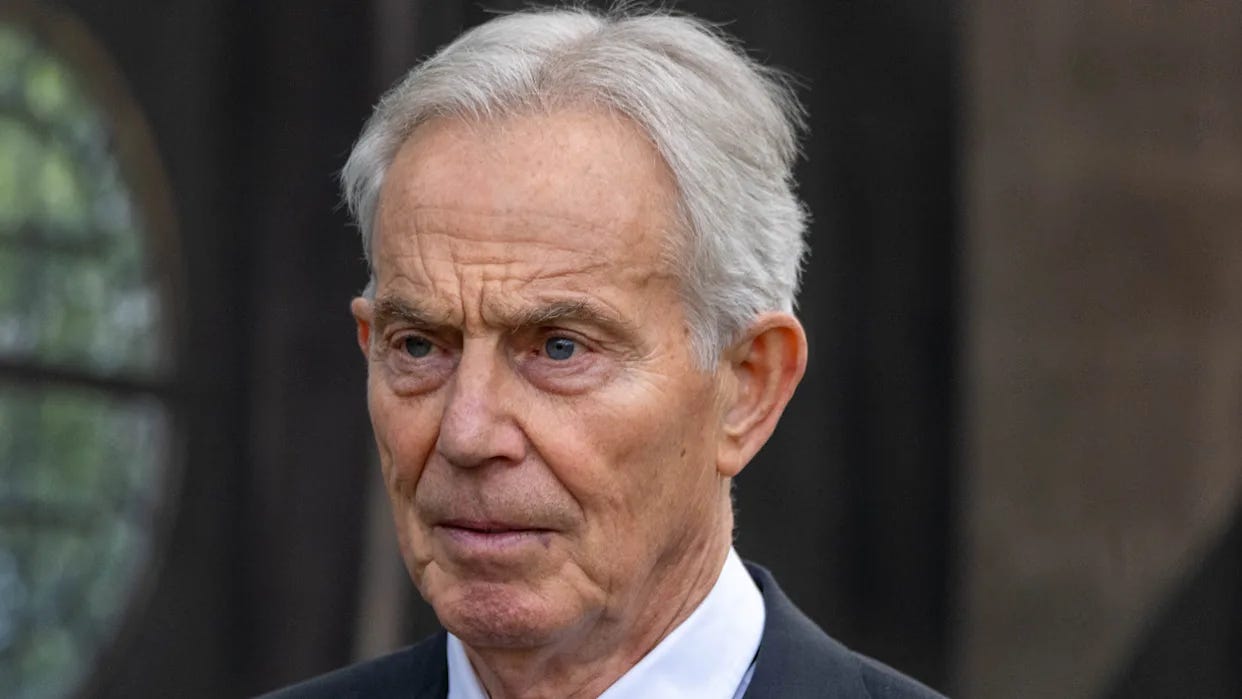
I’ll be interested to hear what Tony Blair has to say when he’s in the dock at The Hague, prosecuted for the illegal war in Iraq. Until then, we have his latest “intervention” - released through his Tony Blair Institute for Global Change, which the media has been dutifully swooning over.
I want to engage with it seriously, because it tells us something important. Not about how to fix Britain, but about what our elites are thinking, what they’re planning, and why - if they get their way - we are heading for catastrophe.
Before we get to the substance, a word on the source. The Tony Blair Institute - and before it, Tony Blair Associates - has been funded by some of the world’s more unsavoury regimes: Kazakhstan, Saudi Arabia, the UAE, Azerbaijan. Millions of pounds from dictatorships. Blair also held paid advisory roles for several of those same governments.
But there’s a more relevant financial relationship here. Tony Blair’s institute has received vast sums of money from Larry Ellison, founder of Oracle. As per the Lighthouse Reports:
While the institute relies on Blair’s political brand, its money comes, in large part, from Ellison, who has had a remarkable 2025. He was briefly the richest man in the world in September, as Oracle’s stake in AI infrastructure drove its share price into orbit…
Ellison invested $130 million in the TBI between 2021 and 2023, with a further $218 million pledged since then. The scale of funding took the TBI from a headcount of 200 to approaching 1,000.
Ellison is positioned at the heart of the AI industry Blair is so keen to promote. His daughter-in-law was chosen to head the government’s taxpayer-backed £500 million Sovereign AI Fund.
All of that is surely crucial context if we are understanding what this “intervention” seeks to do.
Where Blair is right - and where he immediately goes wrong
Blair says the Labour Party is “playing with fire” both with its own future and with the future of the country. On that, I agree with him.
He says Labour does not “have a worked-out, coherent plan for the country in a fast-changing world.” I agree with that too.
He notes that Labour won the 2024 election “not by acclaim” but as an “acceptable default option” to a Conservative government the country had rejected. Again: pretty accurate!
That, however, is largely where the agreement ends - except for his argument that Britain needs to move from cure to prevention in healthcare. Though, of course, any serious preventative health strategy would require an all-out war on social inequalities, which is not exactly the politics Blair is offering.
Blair claims that, “partly because of the intellectual wasteland of the Corbyn years,” Labour had “no properly thought-through analysis of how the world was changing and what that meant for policy.”
This gets things precisely the wrong way round.
Corbynism triumphed in the Labour Party in 2015 because the Labour Right - Blair’s faction - was politically and intellectually exhausted. It had a model: an economy dependent on the financial sector, using the resulting tax revenues to fund investment in public services. That model imploded in 2008. Since then, Britain’s economic settlement has failed to provide sustainably rising living standards, security or decent public services.
The Labour Right had no answer to that. It still doesn’t. And nor does Tony Blair.
They had the entire period of Corbyn’s leadership to develop one. They could have used those years to ask why they lost, to reckon honestly with the exhaustion of their politics, and to construct a compelling vision for the world we now inhabit. Instead, when Keir Starmer’s team took control of the Labour Party, they did so by lying through their teeth to the membership - and then spent that time in Opposition failing to develop any coherent vision.
Perhaps it is time to arrive at the inescapable conclusion: they are never going to develop the answers.
Starmer has not governed as a “soft left” prime minister
Blair claims the government is “governing from an essentially traditional Labour ‘soft left’ position, parked firmly in the party’s comfort zone.”
This is simply untrue.
Starmer has done almost everything the Labour Right asked of him. He has waged a ruthless assault on the left - more ruthless, in fact, than anything Blair himself attempted. He has treated fiscal rules as holy writ, and launched assaults on the welfare state - from the winter fuel payment to disability benefits.
Yes, the government has introduced some social reforms: modest improvements to workers’ rights, bringing rail services into partial public ownership, and a clean energy agenda. But even these are fragmented and limited.
It is worth remembering that New Labour’s first term, for all its abject failures, delivered more sweeping progressive reforms than this government has managed: such as the minimum wage, major investment in public services, Sure Start, the Human Rights Act, tax credits, devolution, LGBTQ+ rights.
Based on his essay, I do not believe for a second that the Tony Blair of today would introduce those policies.
As for this “soft left” Labour government. Take the NHS. Even with current increases, health spending is rising at a much lower rate than under New Labour at its peak: roughly 2.4% to 3% real-terms annual growth now, compared with around 6% to 7% in New Labour’s heyday.
What Blair barely engages with is the obvious question: if this is a left-wing Labour government, why has a party to its left - the Greens - dramatically risen and taken so much of its support?
Surely he must therefore conclude that a significant chunk of the electorate has moved to the left? Why does he think that has happened? Does it make any difference to his political calculations at all? Answers - there are none.
Workers’ rights are not the enemy of prosperity
Blair suggests Labour’s policies are restricting economic growth, the prerequisite for prosperity and social justice. He particularly has workers’ rights in his sights.
This rehashes the same dogma that has dominated Britain for nearly half a century. Thatcherism smashed the trade unions, stripped away workers’ rights, privatised and deregulated the economy, and slashed taxes on big business and the wealthy. The result was not some golden age of shared prosperity. Average economic growth has been weaker and far less fairly distributed than in the decades when Britain had nationalisation, strong trade unions and higher taxes on the well-off and big business.
It is also worth noting that Scandinavian countries, with stronger trade unions and better workers’ rights, have higher living standards than Britain.
What is Blair’s answer to that?
He asks: “How do we justify adding to the welfare bill when it is already ballooning, taxes are high and getting higher, and we’re told we have to increase defence spending to prepare for the possibility of war?”
There are several points to make here.
First, welfare spending is projected to rise from £315 billion to £407 billion by 2030–31. But most welfare spending goes to pensioners, and about half of the projected rise is due to pensioner spending - not least because Britain has an ageing population.
Second, we spend vast sums topping up low pay. That is not an argument against workers’ rights or trade unions. It is an argument for them. If workers were paid properly, the state would not have to subsidise poverty wages on this scale.
Third, we spend huge amounts on housing benefit because Britain flogged off council housing and failed to replace it. Around four in ten former council homes are now owned by private landlords, often charging rents at twice the level of the social sector. Building council housing would reduce the housing benefit bill, stimulate the economy, create jobs and increase tax revenues. It has a multiplier effect.
Fourth, yes, there are deeper social crises - not least a worsening mental health crisis - that require us to address causes as well as symptoms.
But above all else - as Paul Johnson - formerly director of the Institute for Fiscal Studies - points out:
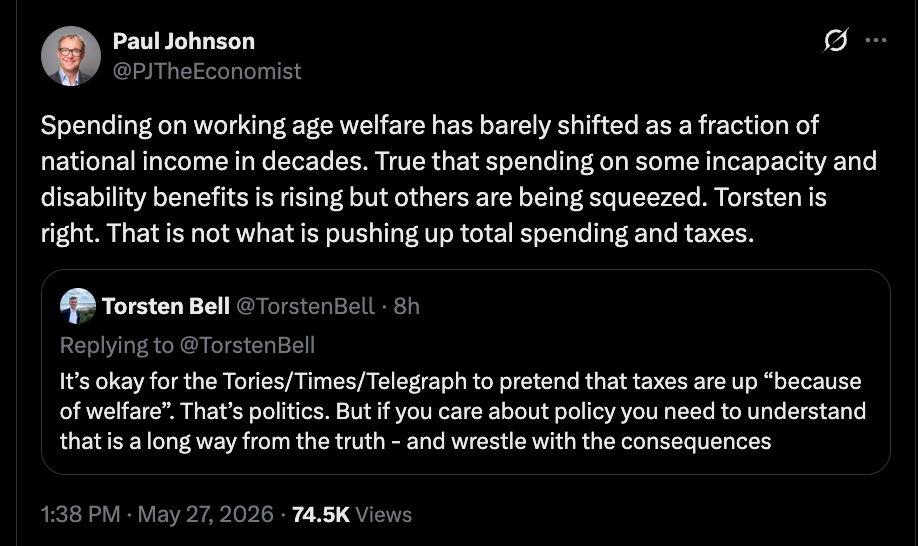
Blair’s premise is simply false.
As for defence spending, we are going to have to disagree. Defence is the one area of public spending that is almost never subjected to proper scrutiny. That is how Britain ended up wasting billions on aircraft carriers that the former chief of the defence staff, David Richards, called “unaffordable vulnerable metal cans.”
Spending money intelligently on cyberwarfare and genuine security threats? Yes. An arms race that increases the risk of nuclear apocalypse, drains money from public services, worsens living standards and fuels the disillusionment on which right-wing authoritarians thrive? Absolutely not.
Blair’s attack on net zero is wrong - and dangerous
What is most striking is that net zero is really in Blair’s sights.
“Does our economy need right now the goal of clean energy or cheap energy?” he asks.
It is quite something to make that argument when Britain has just experienced its hottest May days ever recorded. Who should we listen to: the scientific consensus warning of an existential climate emergency, or a man whose organisations have been funded by multiple foreign dictatorships?
Blair is wrong even on his own terms. Clean energy is cheap energy. For new electricity generation in Britain, renewables are much cheaper than fossil fuels.
He presents climate action as a luxury that Britain cannot afford. The truth is the opposite. The climate emergency is already imposing costs: on homes, infrastructure, food systems, health, insurance, public services and human life itself. The choice is not between cheap energy and clean energy. It is between planned transition and escalating chaos.
The “last 40 years” were not a left-wing fantasy
Blair attacks what he calls “a rehash of the far-left critique about nothing good coming out of the last ‘40 years’ of ‘neo-liberalism’, which presumably includes the last Labour government.”
But it is simply a fact that the Thatcherite settlement has dominated Britain for nearly half a century. As Tony Blair put it when Margaret Thatcher died: “I always thought my job was to build on some of the things she had done rather than reverse them.”
That period has been defined by lower and more unequally distributed growth, rising insecurity, and ever-increasing political turmoil.
It has left us with an over-financialised economy, where investment is siphoned off into share buybacks and dividends. It has left much of the country with crumbling infrastructure, vast regional inequalities and chronically low productivity.
Blair has almost nothing to say about any of this.
That is because to reckon with it honestly would mean reckoning with his own record. Blairism did not overturn the Thatcher settlement. It tried to soften the edges - by depending on an economic model which was itself unsustainable.
Blair does not understand the left threat to Labour
Blair warns that “when we lose seats to the right” it is a delusion to think the country wants Labour to move left.
This underlines how much he is living in the past.
When Blair was prime minister, he did not have an insurgent party seriously challenging Labour from the left. In his political universe, the left are illegitimate, marginal and electorally irrelevant.
That has now been disproved.
Labour just lost a parliamentary seat to the left - to the Greens in Gorton and Denton. It lost hundreds of council seats to the left in the recent local elections. And it lost other seats to Reform because voters who could not stomach Labour went Green, allowing Reform to come through the middle.
Blair makes no attempt to understand this phenomenon, because it contradicts his entire worldview.
What Blair actually wants
Strip away the rhetoric about modernity and “the future,” and what does Blair want?
He wants Labour to abandon its workers’ rights package. He wants it to weaken net zero commitments. He wants the government to scrap real-terms increases to the minimum wage. He wants it to water down modest non-dom tax changes. He wants deregulation, welfare cuts, more North Sea drilling and higher VAT.
Higher VAT - that’s real economic genius stuff in an age of inflation, not least inflation worsened by the Iran war Blair wanted Britain to be more involved in.
Indeed, Blair thinks Labour should have granted access to British military bases for offensive attacks on Iran. As it is, Starmer already offered up bases. But Blair wanted more. This is a man who plunged Iraq into blood and chaos in a criminal war, sent British soldiers to die in an Afghan war that ended with the Taliban re-emerging stronger than ever, and now believes Britain should have played a deeper role in an illegal war on Iran.
This is a man incapable of learning anything.
What he demands is that Britain become even more slavishly loyal to Donald Trump - whose far-right presidency is currently in a tailspin because of defeat in Iran.
What on earth would be the point of a Labour government that did all this?
Millions of people have already asked that question and abandoned Labour for a party to its left. If Labour abandoned even the few progressive commitments it still has - and it is almost impossible to identify any progressive elements in Blair’s alternative - then it would collapse as a political force.
Transparency, honesty - and the “hidden power of elites”
Blair writes: “The challenge of democracy is not transparency, honesty or conspiracy theories about the hidden power of elites. It is efficacy. It is the ability to get big things done.”
But of course - we cannot be having “conspiracy theories about the hidden power of elites,” can we?
It is apparently conspiratorial to look at corporate lobbying. Or political donations. Or the revolving door between political power, big business and money. Very convenient for Tony Blair, that - because it allows him to dismiss scrutiny of himself and his friends as paranoia.
But transparency and honesty are not distractions from getting big things done. They are prerequisites. Without them, decisions will inevitably be made in the interests of rich and powerful people, while everyone else is told those decisions are simply inevitable.
Transparency, honesty and efficacy are not opposites: they belong together.
The AI revolution - and who it will serve
Blair’s real obsession is artificial intelligence.
The politics he promotes is what he calls the “Radical Centre,” which he says “starts from the proposition that governing in the age of AI will be the principal challenge. And opportunity. The route to economic prosperity and social justice.”
As per the “transparency” Blair is contemptuous towards, here is a man with extensive financial links to AI.
Blair says the AI revolution is coming, with all its upsides and downsides, and that everyone simply needs to accept it. And I do accept that it is happening. The question with any technological revolution is not whether it happens. It is in whose interests it is managed.
In the 2000s, Blair spoke about globalisation almost as though it were the weather: an inevitable fact of life, something happening whether you liked it or not, something you might as well accept rather than bark at thunder.
But globalisation was managed in the interests of elites. It created insecurity, dislocation and a furious backlash - which is what we are currently living through. As a result, globalisation is falling apart.
If the AI revolution is run in the interests of corporate elites, it will have devastating consequences and provoke a colossal backlash of its own.
That is why it matters that Blair’s essay calls for Britain to lobby the EU to deregulate the tech industry. And that is why his own direct links to the tech industry, and specifically to AI, must be emphasised.
Blairism helped create this crisis
The truth is that Starmer has already enacted much of the agenda Blair wants. Some of Blair’s key people literally went to work for Starmer to make sure that happened.
What Blair is now demanding is not some bold leap into the future. It is not far from what Liz Truss tried to enact in 2022, with catastrophic consequences: deregulation, tax shifts that hit ordinary people hardest, a genuflection before business, and the fantasy that if you give the already powerful even more power, prosperity will somehow trickle down.
Britain is in the state it is in because, in large part, of Blairism.
His governments failed to address the crises embedded in Britain’s economic model: financialisation, inequality, insecurity, weak productivity, the hollowing-out of industrial communities, the overdependence on the City, the deference to American power.
Those failures helped plunge Britain into disaster. They helped produce political turmoil. They helped create the very real threat of right-wing authoritarianism destroying our democracy.
And now Blair’s followers are demanding we take the same road again - only faster, with fewer protections, more deference to billionaires, and more loyalty to an American empire in decline.
That is not the future. It will simply accelerate our march towards oblivion.
Why now? What’s the hidden agenda? This came out of the blue, so why now? I’m cynical and suspicious.
An excellent critique, one of your best, and an absolute demolition of the criminal Blair.