


Three days into the US-Israeli illegal war on Iran, and the Western media is playing its usual role.
We saw it in Iraq. We saw it in Afghanistan. We saw it in Libya.
We are seeing it in Israel’s genocide in Gaza.
Let’s start with the BBC. There were two stories next to each other on the BBC website.
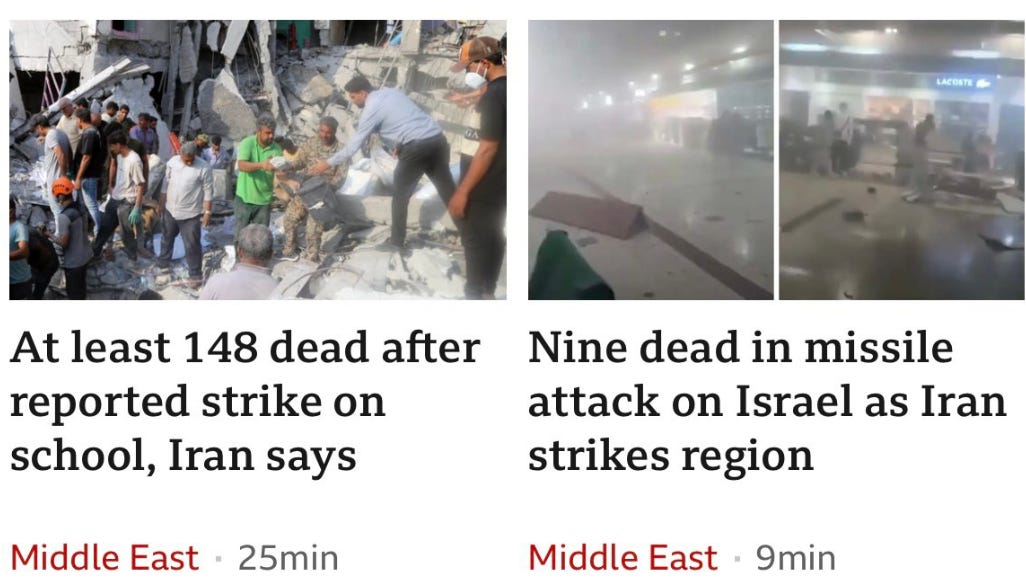
When Iranians are killed - in this case overwhelmingly children - the perpetrator isn’t named. The Israeli-US attackers disappear from the sentence. The deaths are merely “reported”, and attributed to Iran - a source readers have been trained to distrust.
But when Israelis are killed, the perpetrator is clearly identified. It’s presented as fact. Not “reported”. Not “Israel says”. Fact.
Now imagine the reverse.
Imagine an Iranian strike had bombed an Israeli school and killed 165 mostly Israeli children.
Can you picture the response?
It would dominate every front page and every news bulletin.
The faces of those children would be everywhere.
We would see photos of them playing, hear about their hobbies and dreams.
We would hear from grieving parents.
Western politicians would line up to denounce the barbarism of the Iranian regime.
But not here. Because it’s very clear whose lives are centred — and whose are treated as abstract statistics. It’s clear how the crimes of the West are narrated — and how the crimes of its opponents are.
And then there was a Sky News report about the Iranian attack on Beit Shemesh in Israel.
“This Is What Iran’s Rage Looks Like”
And then there was a Sky News report about the Iranian attack on Beit Shemesh in Israel.
“This is what Iran’s rage looks like,” the reporter tells us in sombre, almost grieving tones. “The town of Beit Shemesh, just a short drive away from Jerusalem was hit by a missile. The explosion flattened a school, a synagogue, homes and a bomb shelter - where dozens had sought refuge.”
Could you imagine a Sky News reporter describing an Israeli attack on Gaza with “This is what Iran’s rage looks like”, followed by an emotive sounding description of the impact?
Indeed, look at this Sky News headline about the attack in Israel.
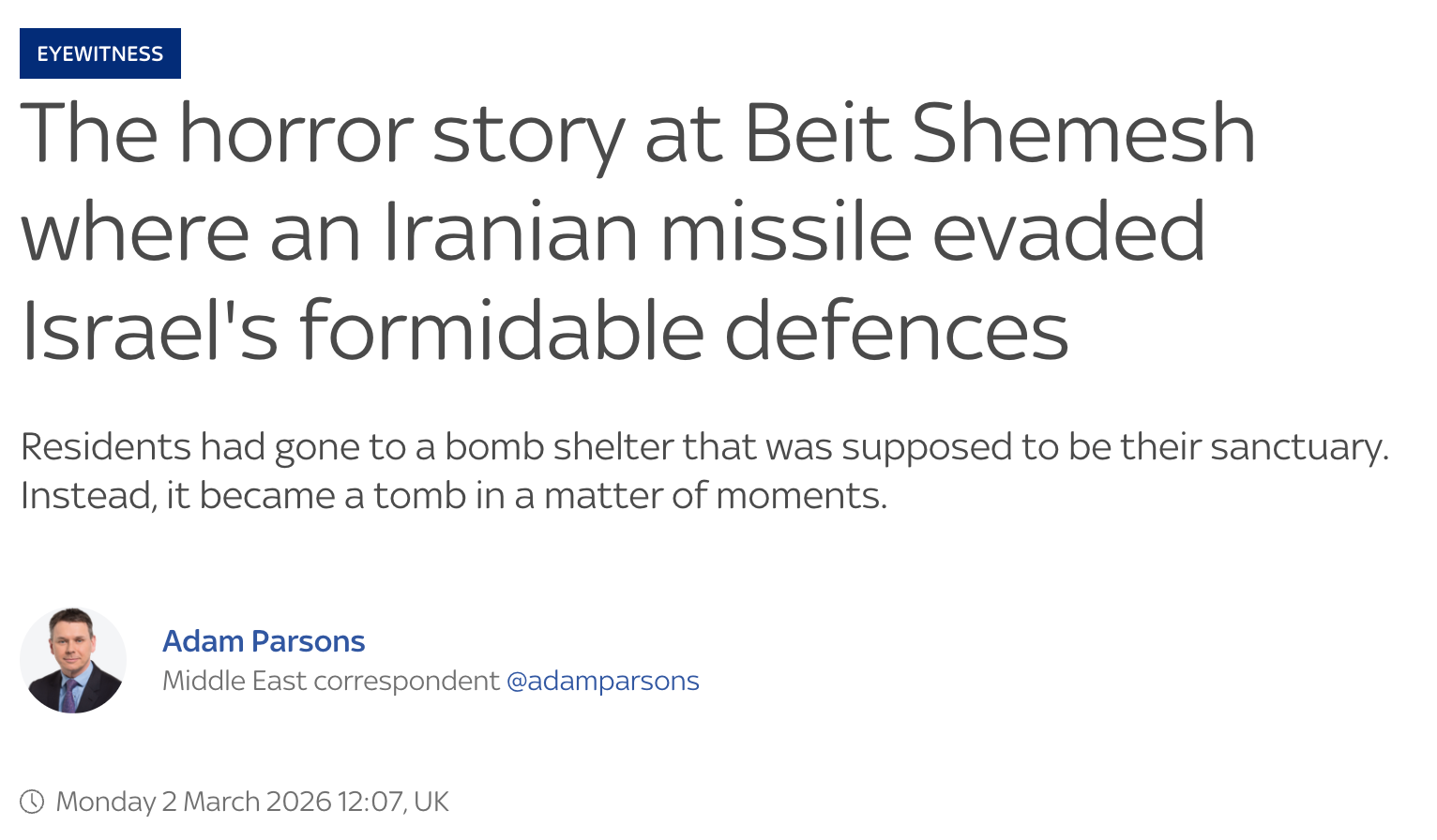
Can you imagine them putting ‘horror story’ in a headline about one of the countless Israeli atrocities in Gaza? Or a subheading about all those countless Palestinian civilians taking shelter in schools hit by Israeli missiles, describing how it was “supposed to be their sanctuary”?
The New York Times is at it again
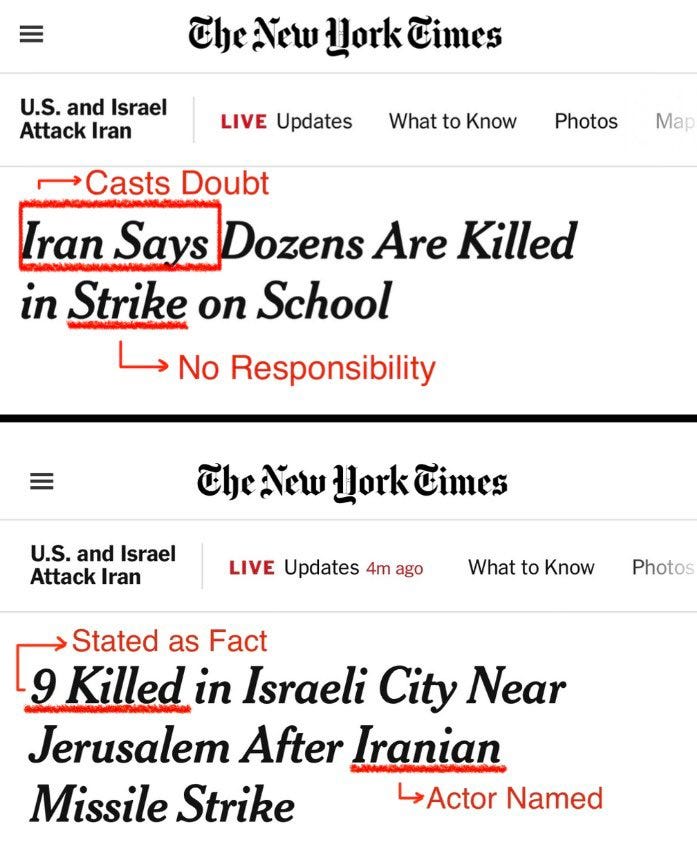
Or take these headlines from the New York Times.
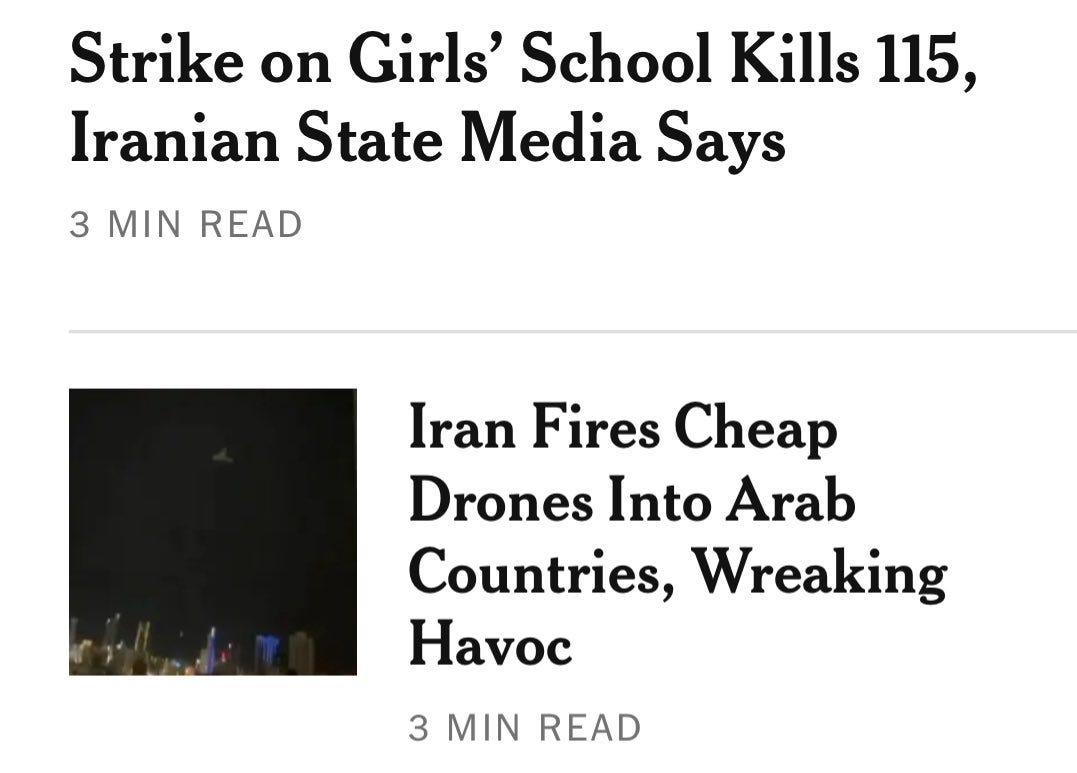
The first headline doesn’t name the perpetrator, and reduces it to ‘Iranian state media says’, which immediately sows doubt - because it encourages the reader to think it’s regime propaganda.
But when it’s Iran attacking, then the perpetrator is named, and there is an emotive description - ‘wreaking havoc’
The brilliant analyst Assal Rad gives two other examples from the newspaper - and identifies the problems.
“Transforming” Iran
And then there’s a report from the BBC’s Clive Myrie.
He describes the attack on Iran as “Israel and America seek to transform Iran.” It makes this illegal and unprovoked attack (details he doesn’t notice) sound like some sort of positivereform project.
Or what about this in the Telegraph:
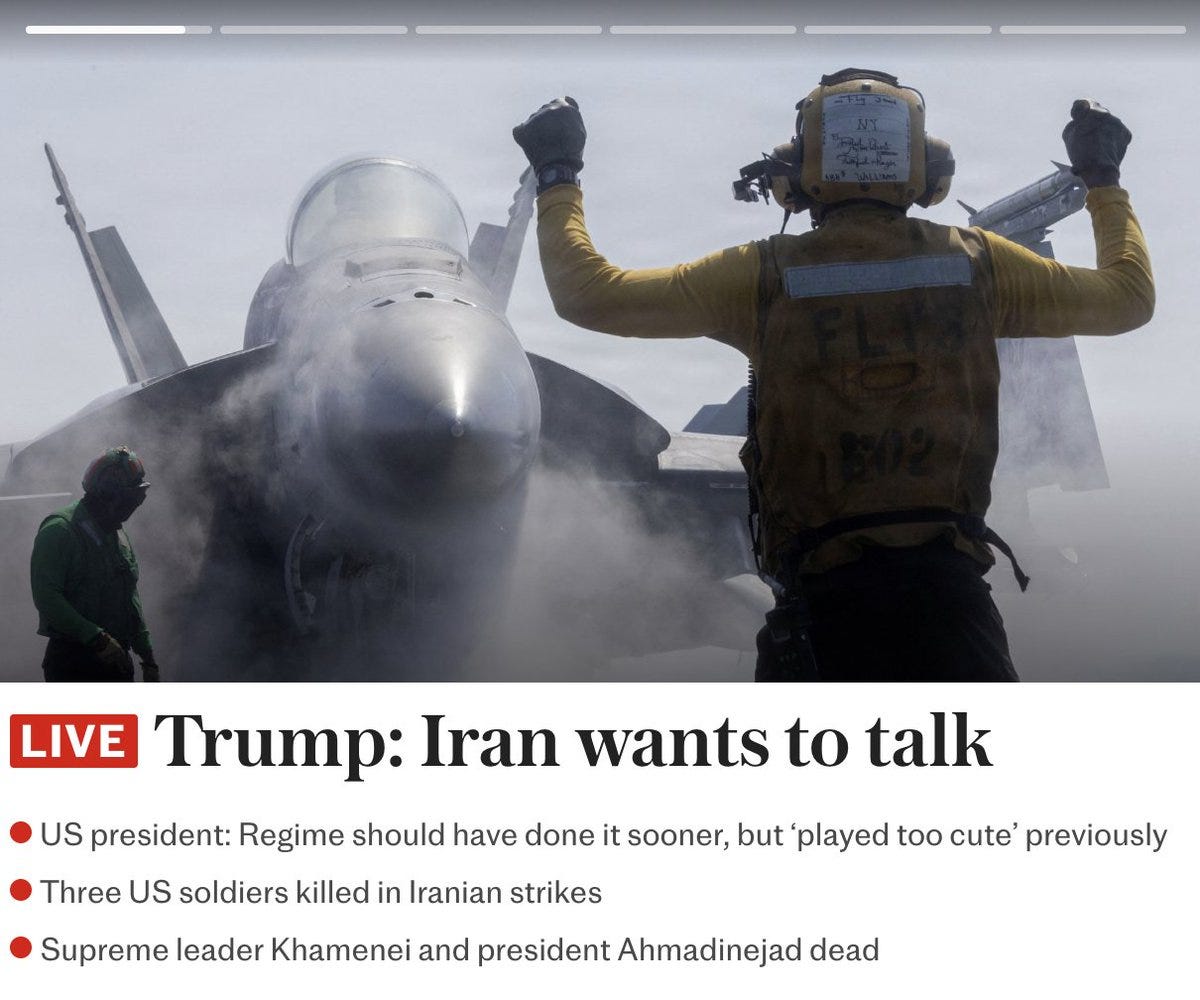
Reading this, you'd think Iran started a war and is now suing for peace. But Iran was "talking" in negotiations, which the US and Israel ended by bombing them.
A Rare Exception
There was at least one positive exception.
On Channel 4 News, Foreign Affairs Correspondent Secunder Kermani challenged an Israeli spokesperson directly:
“Your prime minister is a wanted war criminal. You don’t have the moral high ground here at all.”
The fact that the International Criminal Court has an arrest warrant for Israeli Prime Minister Benjamin Netanyahu on charges of war crimes and crimes against humanity should always be integrated into coverage - not least when he is launching yet another war.
In the coming days and weeks, I’ll be challenging Western media coverage of what is, to repeat, a blatantly illegal war.
You can support our expanding project across all platforms by subscribing!
Thank you for telling it like it is. When did journalism die?
Carolyn
Gaza under total blockade , all crossings closed , no entry of humanitarian aid. Collective punishment , hunger used as weapon. Again. And again silence , no reporting of this crime against humanity on MSM .
Under cover of illegal, unlawful, unprovoked aggressive bombing campaign , a joint venture by US/Israel against Iran, Israel continues to pursue its overriding objective - to destroy Palestinians living Gaza - West Bank, and East Jerusalem. Everything goes back to Palestine .
Its existence terrifies Israel .