


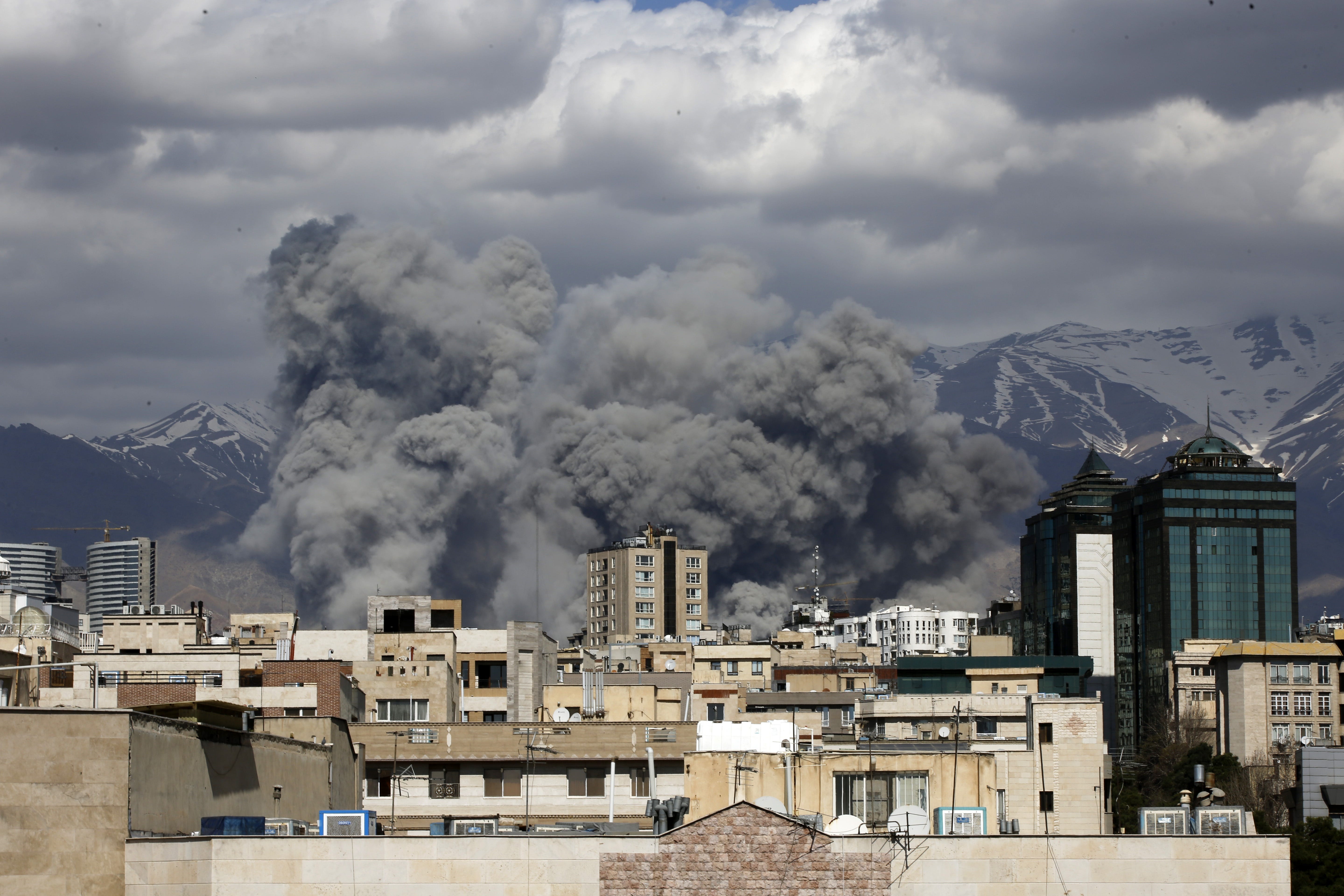
The US is losing its war against Iran. That’s what all the evidence is pointing towards.
Israel has a narrower strategic goal - leave Iran in violent chaos so that it’s permanently weakened and hobbled. That’s a plausible outcome, but it would be destabilising for the West’s Gulf allies and further associate US power with bloody turmoil.
But let’s go through why this is going so badly for the US.
No regime collapse
By assassinating the Supreme Leader, it’s clear that the US believed it had achieved regime decapitation. The system would come crashing down like a pack of cards, or so they thought. There would be defections by the Islamic Revolutionary Guard Corps and some sort of coup.
But there are no apparent cracks in the regime at all.
When asked about the timeline for the conflict, War Secretary Pete Hegseth said: “We could say four weeks, but it could be six, it could be eight, it could be three.”
Such a protracted conflict is clearly not what the US originally had in mind.
Yesterday, Donald Trump dismissed the exiled Crown Prince and son of the deposed Shah, Reza Pahlavi. That’s despite Pahlavi’s fanatical pro-US orientation, and his zealous support for bombing his country of birth.
Last July, Reza Pahlavi claimed that 50,000 officials from within Iran’s ruling government and military had contacted him to sign up to defect and collapse the regime. If that was true, do you think for a second that Trump wouldn’t be backing him?
Instead, Trump has proposed an equivalent of what happened in Venezuela. You take out the leader and replace them with someone from the government, in that case Delcy Rodríguez, and put a gun to their head and order them to do what the US and Israel wants.
But as a former Israeli intelligence officer, Danny Citrinowicz puts it, they have completely misunderstood Tehran's strategy and calculations.
He says that Iran “will not relinquish its missile arsenal, nor will it forgo what it defines as its right to enrich uranium.” The only path to clear victory is regime change, and he says that “it is far from clear that Washington is willing to invest the resources and long-term commitment such an outcome would demand.”
No successor, he says, is likely to present surrender terms to the US, because “capitulation would mean the collapse of the very ideological foundation of the Islamic Republic. Any leader who emerges from within the system will be bound by the same core principles and strategic red lines.”.
So they will keep fighting, he predicts, believing that “time is on their side”. We’ll come to why they think that, but it’s worth noting the mass loyalist crowds that the Iranian regime has mobilised on the streets.
There’s still mass opposition to the regime, no doubt, but it enjoys far more support than Saddam Hussein, Colonel Gaddafi or the Taliban when the Iraq, Libyan and Afghan wars began.
From history, we know that foreign attacks on a country often rally support; they provoke a nationalist response.
It’s notable that the BBC is quoting residents in Tehran describing their horror at the US-Israeli attacks, saying things like: “Not happy anymore [at the possibility of regime change], no. Just tired. And confused as to what might happen.”
In these situations, when your nation is under attack, it becomes much easier for dissent to be seen as accomplices of the attackers - which is one major reason why aerial bombardment has never led to regime change.
Chaos in the Gulf
How about this in the Telegraph, which is a newspaper with a hard right pro-Israel orientation:
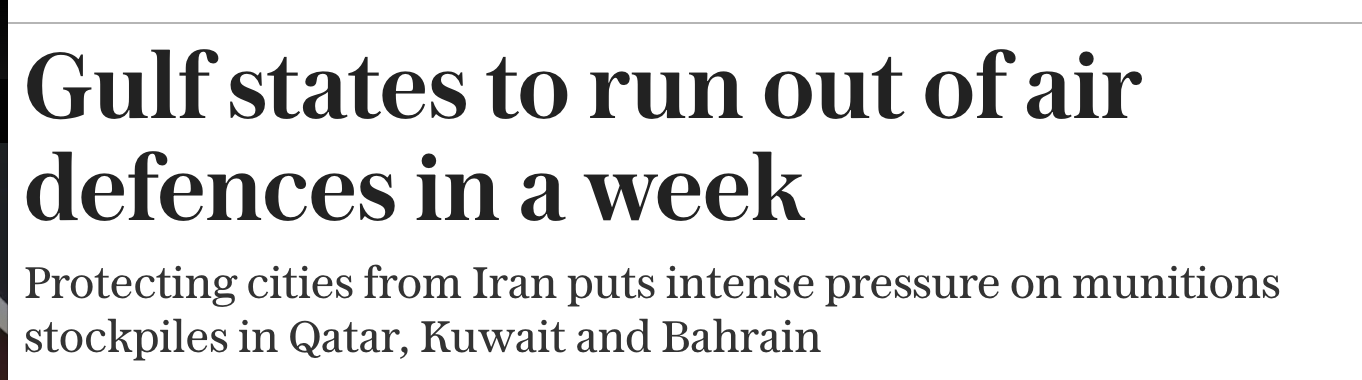
This article notes that many - but not all - Iranian ballistic missiles and drones have been intercepted but that’s only by burning through munitions stockpiles in Qatar, Kuwait and Bahrain.
The Telegraph claims that:
Iran is believed to still have vast reserves of missiles despite attempts by US and Israeli forces to destroy launchers capable of deploying them.
The War Secretary, Pete Hegseth, today boasted that the number of Iranian missile and drone attacks had dramatically reduced. That’s down to US-Israeli attacks, he argues. That could be part of it, but there are other explanations. One US official suggests it could be that “Iran is holding back missiles so its operations can last longer”.
But each drone only costs between $20,000 and $50,000 to make, but a Patriot interceptor missile used to destroy just one costs $4 million. These Iranian drones can be launched from the back of a truck.
In other words, Iran could attack these Gulf countries on the cheap as they burn through air defence. These are states that marketed themselves as oases of calm and stability - allowing their economies to be boosted by rich Westerners.
Crucially, being US military allies was supposed to protect them. Instead, it’s made them targets.
It’s the oil (and economy), stupid
Yes, I’m going to quote the Telegraph again. Their international business editor Ambrose Evans-Pritchard has a story headlined ‘Energy markets will force Trump to end his reckless war very soon’.
He notes that it was “more than a little careless” to plunge the Middle East into turmoil without replenishing the US strategic petroleum reserve, which is nearing its lowest levels in four decades.
He adds it was “even more careless” to launch a war of aggression when the oil industry in the Gulf doesn’t have the pipeline infrastructure to replace the global dependence on shipping through the Strait of Hormuz, where 20% of the world’s oil passes through, which Iran declared had been closed.
Iran says they’ve got complete control of the strait and will set any ship passing on fire. In any case, maritime insurers have cancelled war risk cover for any ships, which will stop almost all of them from chancing it.
Evans-Pritchard says there is zero spare capacity in the rest of the world. He quotes Jim Burkhard, who is head of oil markets at S&P Global Energy, who says that this war threatens to cause the biggest oil supply crisis of our time, even more so than the Arab oil embargo of 1973 - which had colossal global consequences - and that wasn’t when the world was already in a very severe and protracted set of economic crises.
Energy prices are already surging, he notes, but have a long way to go - and it’s Europe which faces particular devastation.
We’re already seeing economists warn of interest rate hikes, which would cause further economic turmoil. And that’s already when so many have been predicting a crash coming anyway - like the former head of Goldman Sachs, who was in charge during the 2008 financial crisis, who said he saw parallels today with that disaster.
Arming Kurdish militias
Donald Trump has called the leaders of Kurdish militia, while CNN reports that the CIA is working to arm Kurdish forces to spark an uprising in Iran.
This will alarm a lot of Iranians who hate their government. It will look like an attempt to plunge Iran into civil war and promote balkanisation - that is, an ethnic conflict which fragments their country.
Note that the exiled Crown Prince Reza Pahlavi has denounced those Kurdish groups - indeed his father severely repressed the Kurdish people.
He posted on social media:
In recent days, several separatist groups—some of whose records include collaboration with both Khomeini and Saddam—have made baseless and contemptible claims against the territorial integrity and national unity of Iran.
Like his father, Pahlavi believes in a centralised unitary Iran. But he also knows that Iranians opposed to the regime will be bitterly opposed to their country being broken up.
And that’s clearly what Israel would dearly like. They want an Iran which splits apart so it never has any significant power in the region.
The Jerusalem Post reflects that thinking when last year it set out a five-point plan for Trump, including:
Forge a Middle East coalition for Iran’s partition. Encourage long-term plans for a federalized or partitioned Iran, recognizing that Khamenei’s theocratic regime cannot be reformed. Offer security guarantees to Sunni, Kurdish, and Balochi minority regions willing to break away.
That the US is resorting to arming Kurdish militants - despite knowing the likely response this will provoke from many Iranians - is a sign of desperation.
US politicians begin to panic
And let’s note the increasingly panicked comments of US politicians, not least after they received a confidential briefing.
Senator Elizabeth Warren says “it is so much worse than you think,” and that the Trump administration has no plan.
Senator Richard Blumenthal, meanwhile, suggests that the supposedly ‘confidential’ element being held back from the American public is to deploy US ground troops alongside Kurdish militia.
In other words, a quagmire beckons.
“Unprecedented”
According to Lord Peter Ricketts - the former National Security Advisor to the British government:
It is, I think, completely unprecedented to launch a war of this scale when you don’t know what it’s about.
Iraq, Afghanistan and Libya did have clear goals. They were still catastrophes. This time round, there is no clear goal.
No wonder establishment intelligence types are panicking.
Western leaders are panicking
And what about Western leaders? They’re clearly beginning to panic.
Canadian Prime Minister Mark Carney originally backed the war, but now says they are “inconsistent with international law”. He adds: “The current conflict is another example of the failure of the international order.”
French president Emmanuel Macron says the attacks were conducted “outside of international law” and his government “cannot approve of them”
Even Starmer, though involving Britain in this illegal war by offering up British bases, says:
What I was not prepared to do on Saturday was for the UK to join a war unless I was satisfied there was a lawful basis and a viable, thought-through plan. That remains my position.
In other words, he says the war isn’t lawful and doesn’t have a viable thought-through plan.
These Western leaders are not inviting Trump's potential fury for no reason. They clearly believe - no doubt based on what their military and intelligence services are telling them - that this is a disaster.
Sapping US power
Trump’s army chief, General Dan Caine, fretted about this war because US munitions stockpiles had already been burned through because of support for Ukraine, as well as Israel’s genocide.
But who does this benefit? China, of course. The US has shifted its military assets away from the Indo-Pacific region. It benefits what Trump and his faction identified as their main strategic rival.
But a hideous cost
None of this means, of course, that the US and Israel cannot cause so much more damage and kill so many more people. According to Human Rights Activists in Iran this morning at least 1,097 civilians have been killed, including 181 kids under the age of 10.
Those are likely to be drastic underestimates, not least given the internet has been shut down - and they’re already out of date.
And we return again to the Telegraph, which has a shocking headline:
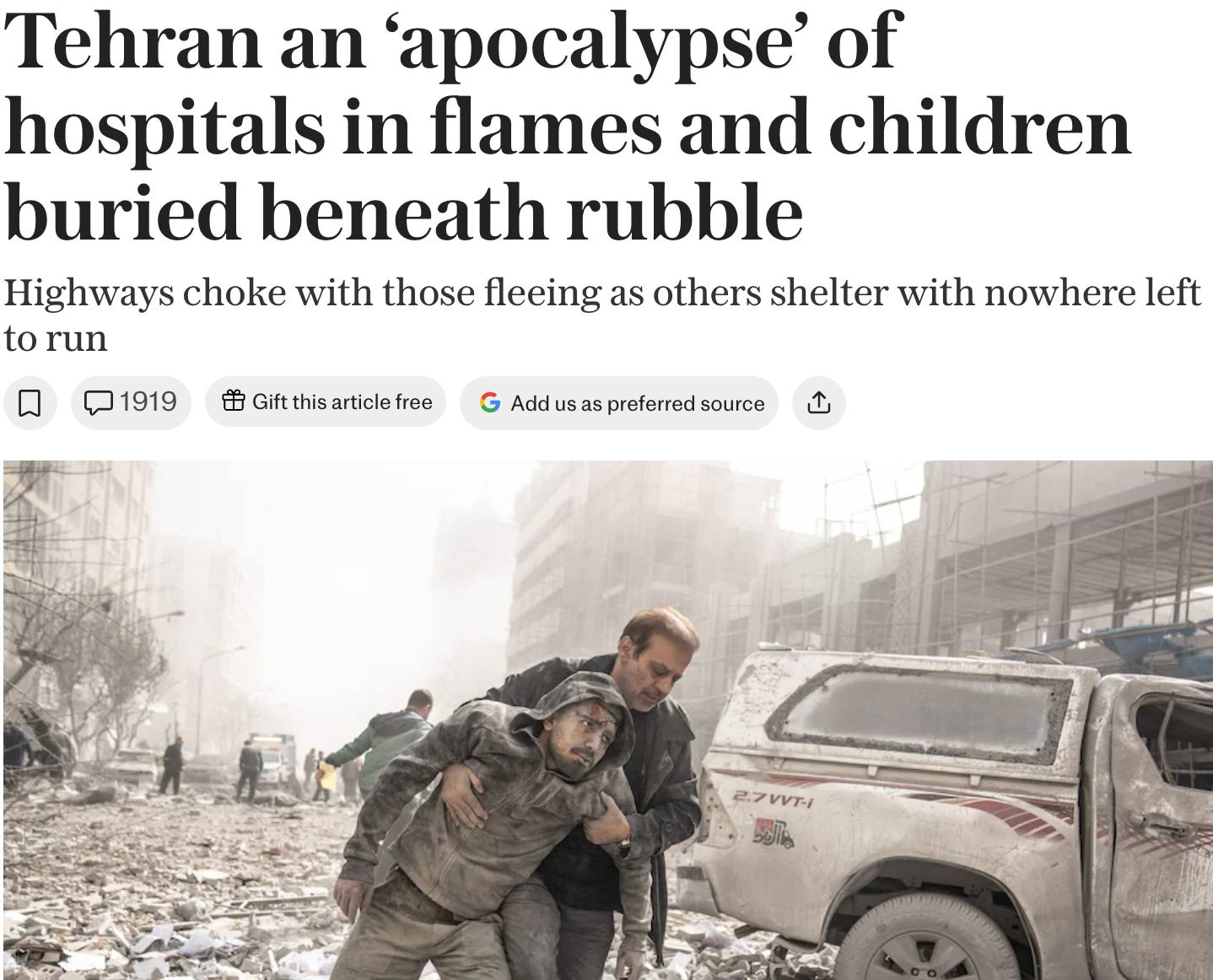
The article begins:
Bombs have struck hospitals, schools and residential buildings in some of the heaviest strikes on Tehran since the war began.
Witnesses described “apocalyptic” scenes under the relentless barrage on Tuesday as food and medical supplies dwindled and the death toll rose.
The pillars of Iranian civil society are being destroyed, like Enghelab Square, a cultural centre, and we can see pictures of terrible damage and destruction inflicted there by US and Israeli bombs.
There’s terrifying footage of Tehran - a city about the size of New York City - being bombed.
Pete Hegseth boasts that when air superiority is established, that will mean: ““Death and destruction from the sky. All. Day. Long.”"
This worship of violence smacks of depravity. But this, too, will rot away US power. The moral claims used to justify that power were already shredded by the Iraq war, the ‘war on terror’ and of course Israel’s genocide.
But as well as surely causing growing fury amongst many Iranians, it once again associates the US with violence, death and destruction.
A terrible crime is being committed. But this is not a war which is going well for its chief belligerent.
"Smacks of depravity?" It is DEPRAVED. Without any adverbial modifiers.