


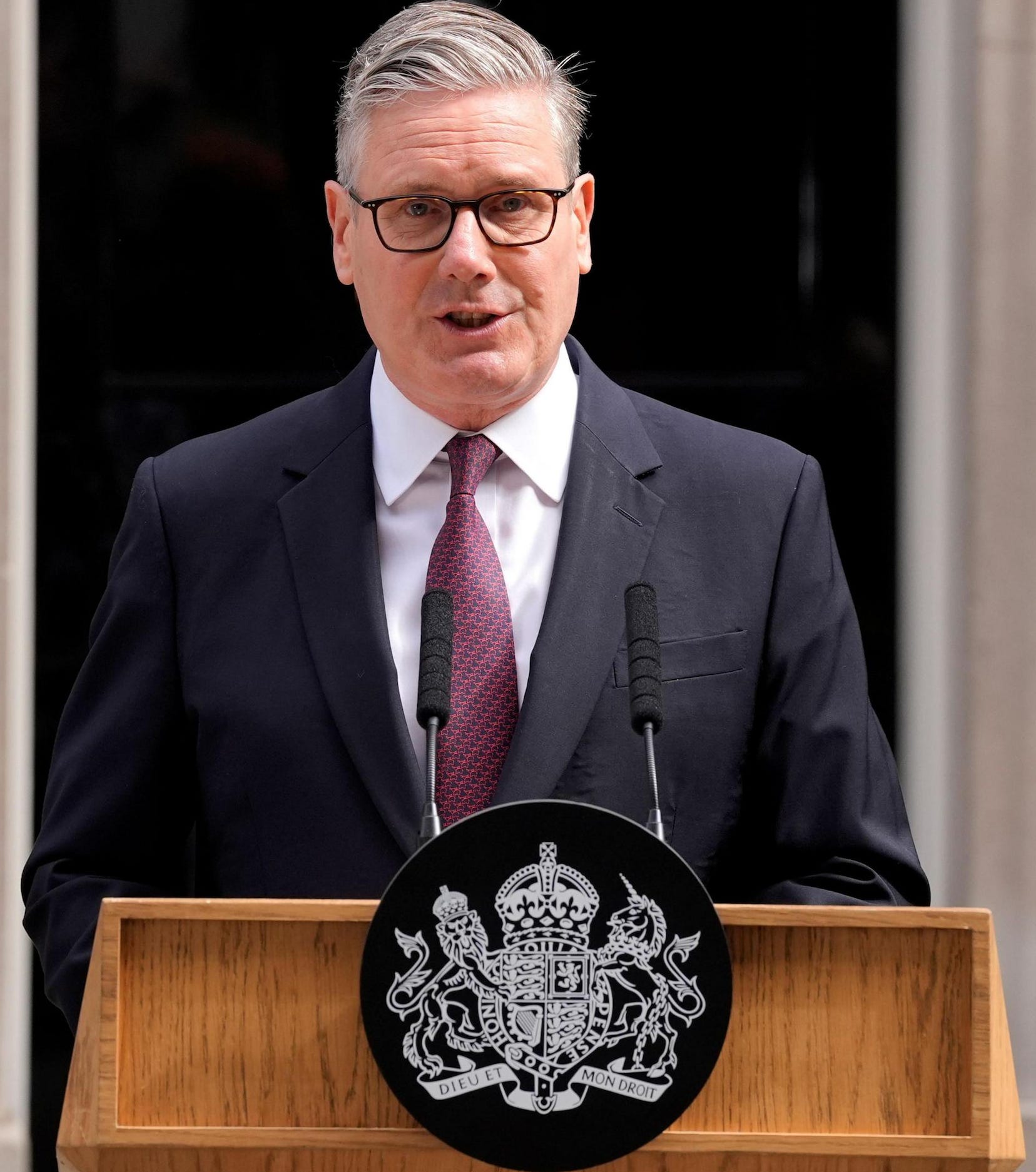
Years before he entered No. 10, it was obvious that Keir Starmer’s project would end in catastrophe. It was entirely predictable - and indeed, predicted.
Well, by those of us on the left. Not by the vast majority of “mainstream” commentators.
I told you so’s are always undignified. I offer no apologies. These predictions were ridiculed at the time - but we can’t move forward unless it’s understood why Starmerism has fallen apart.
In years of Opposition, Starmer proved that his project was always defined by dishonesty, that it had no vision for the country, and that its arrogant architects weren’t even up to the job.
A caveat. I didn’t vote for Keir Starmer to become Labour leader - I voted for the left-wing standard-bearer Rebecca Long-Bailey. When he won the 2020 leadership contest, I nonetheless accepted his victory in good faith, conditional on him sticking by his leadership pledges.
The political direction of his leadership swiftly became very clear. Here is what I criticised - and predicted.
In October 2020, after Labour abstained on a Conservative bill making it legal for undercover agents to commit sexual assault, torture and murder, I wrote:
For the second time in as many weeks, Labour offered a vacuum in place of leadership against state-sanctioned violence against civilians. It has paid a profound moral price, and conceded yet more ground to its opponents.
(I should note that, in this period, Keir Starmer would repeatedly contact me to object to my criticisms, in one case telling me I was better than this).
In February 2021, I wrote a piece headlined ‘By ignoring young voters, Labour is creating an opening for the Greens’.
I warned:
If the new Labour leadership insists on alienating young people who prefer a strong state to intervene to achieve greater economic and social equality, and transition to a greener economy in order to reduce the impact of the climate crisis, then it may find, as in Scotland and with the red wall, another chunk of Labour’s electoral coalition finds somewhere else to go. A similar phenomenon is happening in Wales, where Plaid Cymru is on the rise and nearly half of young Welsh citizens support independence.
The same month, I wrote that Starmer’s Labour had placed itself to the right of the Tories on tax, adding:
Labour’s opposition to tax increases is yet another illustration of an increasingly obvious truth: the party’s leadership lacks a political soul and is devoid of any meaningful coherent vision for the country it seeks to lead.
I added:
Political direction is coming from the focus groups because Starmer’s team lacks a political vision to guide them. They desperately want to win power, but they don’t know why.
And concluded:
Instead, the Labour leadership seeks power without a vision. That is, to be fair, an interesting political experiment, but one that is unlikely to end well. It is not too late to change course.
In May 2021, I wrote:
Starmer’s team are on safari, knowing nothing about communities they didn’t grow up in, leading to cosplay, caricature and flag-waving, which screeches inauthenticity and nothing more.
The same month:
After a year as leader, Starmer has shown a lack of political vision, a thin-skinned aversion to criticism, and an over-dependence on a small circle of inexperienced advisers, all of which have been on display over the past few days.
Then in June 2021:
Many Muslims, like many young people, who felt listened to under Corbyn’s leadership now feel sidelined, only deemed of use as voting fodder. Whether in this byelection or next time around, they want to give Labour a kicking until they are listened to. That is, after all, how many diehard Scottish Labour voters felt: but when they crossed the electoral Rubicon, they never came back.
In September 2021, I wrote about Starmer’s dishonesty:
Dishonesty corrodes democracy like acid. If politicians make promises they renege on, voters conclude that none can be trusted and disengage from the political process. Accountability – a prerequisite of any functioning democracy – becomes impossible, because if dishonesty is normalised, a priced-in background hum of politics, then objections to the stench of deceit can be shrugged off by politicians on the grounds that all of their colleagues are in the sewer, too.
I added:
When I described Starmer’s team as “maniacs” because of their abortive attempts to reintroduce an electoral college granting MPs disproportionate power in the next leadership election, a shadow minister responded to me: “It’s worse than that: they are incompetent.” Starmer, whose own allies describe him as a man without politics, is surrounded by crude factional figures with an obsessive grudge against the left and no vision for the country.
And I further added:
There is nothing to recommend Starmer’s leadership. He is, as we have seen, unprincipled. He is not honest. Where Blair and Neil Kinnock were talented orators, Starmer lacks any charisma or warmth. He extolled “integrity” in the leadership election, but as his sacking in May of deputy leader Angela Rayner from her role as Labour chair underlined, he has none. That more Labour voters than not desire his resignation, that more than six in 10 people do not see him as a prime minister in waiting, and that he lost the Hartlepool byelection – a seat Labour retained even in the landslide defeat of 2019 – shows he is unelectable. Starmer is Labour’s version of Theresa May – who was originally lauded as a serious, public-spirited politician before being undone by her own cynicism and woodenness.
What I got wrong here was about Starmer being unelectable. But this was entirely down to the Tories’ self-destruction. The column was written before partygate and all of the other Boris Johnson scandals which destroyed him. It was written before the Liz Truss catastrophe. And then there was the return of a ferocious squeeze in living standards, and a collapsing NHS - and all the dire failures of the Rishi Sunak era.
And yet despite being handed the election on a platter - and indeed the Tories’ calamitous election campaign - Labour only won a third of the vote on a dire turnout. They were saved by Nigel Farage dividing the right-of-centre vote.
The points I was making here - about Labour’s dishonesty, their lack of vision for the country, their hatred of the left, and Starmer’s own lack of leadership qualities - are exactly why it all fell apart.
In February 2023, I wrote:
While Starmer’s team behaves as though it’s 1997, Britain’s current state is more like 1974 – that is, in crisis and turmoil. If a Labour government offers only tinkering around the edges of the economy, and the lives of struggling households do not substantially improve, mass disillusionment may soon kick in. It remains the case that the most interesting ideas are bubbling away on the left: banishing them from Labour’s future is an act of self-harm. If a meek Starmer administration disappoints, a now cowed left may find an audience willing to listen. Starmer’s team is buoyant now, and understandably so: but history tell us where hubris leads.
Again, I noted Labour’s lack of vision for the country - and how the left could win an audience as a consequence. We can now see that with the surge of Zack Polanski’s Green Party.
Here’s what I wrote in October 2023, when Labour had a colossal opinion poll lead:
So consider this for a scenario. Labour triumphs at the next election, but wins by default and with no enthusiasm for Starmerism in the tank from the start. Unlike 1997, the new administration rules a country defined by turmoil and decline, but offers no transformative policies to answer our multiple and overlapping crises. Disillusionment sets in, while the Tories complete their metamorphosis into loud, proud, brash rightwing populism, hoovering up votes from the disaffected. In the general election of 2029, a new model Tory party – flushed with British Trumpism – stages a stunning comeback.
True, this is not the US: your gut instinct may say it can’t happen here. But when, in the past, you looked in bemused horror at their culture wars, you may have assumed they’d never arrive on our shores – but they did. Farage marched through conference not as a hostile outsider, but as a conquering general. His mission is not yet complete, however, and a final prize may beckon.
What I got wrong here was the suggestion that Nigel Farage could take over the Tories. But my basic point - a government with no answers to a turmoil-afflicted country would open the door to a Farageist insurgency - was obviously correct.
Here’s what I wrote in December 2023:
Those hoping this is all one big pretence and, once safely ensconced in No 10, Starmer will yell “Surprise!” and enact a new shiny progressive dawn are set to be most disappointed. And this is now the most interesting question in British politics. When Starmer wins his decisive victory – which he will – and little changes after two years, what happens next?
Alas, there were no shortage of Starmer supporters predicting he would enact a shiny new progressive dawn. Here’s Andrew Marr predicted Starmer would be a “radical” prime minister - two months after I penned that column. Alas, it was not to be!
A day after Andrew Marr’s video, in February 2024, I wrote the following:
An administration that lacks meaningful answers to domestic crises and is wedded to a toxic foreign policy will soon find itself in trouble. Look at Starmer’s political equivalents in the US, Germany and Australia: they won but swiftly became unpopular, and none U-turned so comprehensively as him on their original promises. If he enjoys a honeymoon, it will be short-lived.
And here was a key point - Starmer-like politics in Germany was particularly instructive, given the insurgency of the far-right AfD. But of course we also saw what happened to Joe Biden.
Just after the general election was called, I wrote:
Labour will win this election not because there is any real enthusiasm for the party’s agenda nor any real belief in Starmer’s capabilities as a leader. It will win because the Tories have set one of the lowest bars in British political history. And then, when Labour is in power, enjoying so little support and enthusiasm among its natural voters, what next? Winning because people wanted to rid themselves of the incumbent party is not the same as winning because you offered a vision that voters rallied behind.
After this week, the mask is off. Labour’s leaders are sending a clear signal that once they have secured No 10, they will behave with the same power-drunk arrogance and the same disregard for democratic norms that they are showing now towards their own MPs. Starmer should consider, for a moment, the cautionary tale of Boris Johnson – another leader who purged his parliamentary party. Yes, he scooped an 80-seat majority. But then, in less than three years, he was driven from office in disgrace, and the Tory party was left in tatters.
Bear in mind, Labour had a 20 point lead in the polls at the time.
But this is indeed what has happened!
When the election results came in, I noted there was hope:
Despite the excessive media focus on the Farageist insurgency, the left revolt is just as significant. If the Labour leadership was rational, it would acknowledge this disaffection and seek to reverse the rot. The party, after all, has secured the same share of the vote as in 2019, winning its landslide thanks to Nigel Farage dividing the right and the vagaries of our electoral system. The juxtaposition between its dominance of the House of Commons and the lack of enthusiasm it enjoys in the country will be increasingly felt.
But here’s a prediction. Those surrounding Starmer are too politically defined by their hostility to the left to learn from this. There will be precious little conciliation: quite the reverse. In the coming years, growing numbers of voters will be driven to the Greens and other leftwing formations. As long as leftwing forces in Britain build on this moment and find common cause – yes, a big but – then this could be a new beginning indeed.
As I predicted, Starmer’s team ignored the evidence of disillusionment from the left - and simply doubled down on further antagonising the left.
My view was that the big challenge facing the left was a question of leadership. After Zack Polanski assumed the leadership of the Greens, he did indeed build on this moment.
It should have been obvious that Starmerism was an empty project - a vacuum filled by dishonesty, arrogance and a craving for power for its own sake.
But instead Starmer was treated as a competent, serious “grown-up in the room” who would offer a new found stability. The idea, basically, was that we were trapped in a Tory psychodrama - and when the party was ejected from office, all of that would go away.
The basic problem is that most political journalism treats politics as a soap opera.
It’s driven by personality - who’s up and who’s down - rather than ideas and the realities affecting ordinary citizens. There was no understanding of the crises afflicting this country - and Labour’s lack of answers to them.
That’s why Starmerism was so badly misreported.
The raging dishonesty of Starmerism always told us that this would end in catastrophe.
But political journalists ignored his dishonesty.
Why?
Because he used it to destroy the left - and they admired that, and saw it as smart politics.
None of this is evidence of my prophetic skills. It should have been obvious what would happen. It is a damning failure of political journalism that this was not understood.
(This is an updated version of this piece from last year)
When Starmer became Party Leader I got into a bit of an argy-bargy with a colleague who said, “You’ll see. It will be different once he becomes PM.” With my cynical hat firmly in place, I countered with, “He’s showing us every day who he is. He’s not going to change when he becomes PM.” I quit the Labour Party when Starmer said that MPs couldn’t support strikers by going on their picket lines. That was it for me. A Labour Party that doesn’t support labourers. There may have been some positive things accomplished in the past two years, however, as you point out, Labour has become a party without a vision, and without a vision, these accomplishments are arbitrary and don’t create a cohesive through line that explains what kind of Britain the Labour Party wants us to be part of. His being portrayed as a steady hand and a ‘grown up’ , for me, just reinforced an elitist loop that doesn’t effectively change anything. There are times, and this is one of them, when I take no satisfaction in having been right.
Everything you predicted has come true. For me, he became a danger to us all with his unrestrained support for Israel.