


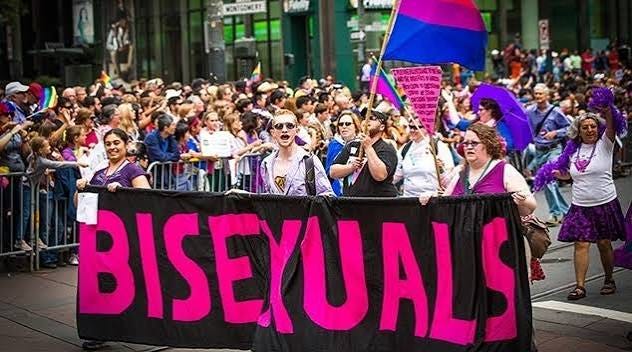
A few years ago, I interviewed a group of bisexual men and women. It was an eye opening experience.
As a gay man, I’d never previously properly considered prejudice against bi people, and even considered them to be relatively privileged. But as they explained to me, they suffered prejudice from straight and gay people alike.
Bi people of both genders faced being deemed problematically promiscuous, “greedy”, and unable to strike lasting romantic relationships.
But bi men and women also had different specific experiences. Bi women suffer a particular type of sexually objectification from straight men turned on by women having sex with each other. Bi men, on the other hand, face being treated by both straight men and women as gay men in denial.
Indeed, if a woman kisses another woman, many men consider that erotic and would not automatically assume either are gay, and might even sexually harass them. But if a man kisses another man - and doesn’t even engage in any further sexual activity - a substantial number of people of both genders would conclude they must simply be gay, full stop.
Which brings us to a new poll published by YouGov. It finds that just 19% of straight women are willing to date a bisexual man, compared to two thirds who say otherwise.
82% of bisexual women, on the other hand, say they would date a bisexual man, with just 10% saying they would not. Likewise, almost the same proportion of gay men say they would date a bisexual man.
Straight men are more divided: 53% say they would date a bisexual woman, with 35% saying otherwise.
There is a major age gap at play. 40% of straight women aged under 35 say they’d date a bisexual man, compared to 9% among the over-55s. That obviously has a real-world impact, because a much higher proportion of the former are dating compared to the latter.
When I shared the survey on social media with the comment “This is why most bisexual men don’t come out,” it provoked outrage.


This largely came from so-called ‘gender critical’ activists: that is, those who have become obsessively opposed to trans rights. The general claim was that I was shaming women and violating the principle of consent: somehow dictating that women should sleep with bisexual men.
Among those claiming that this was evidence of misogyny was former Labour MP Rosie Duffield.


Duffield has form. A few years ago, she claimed “many of her gay friends” are offended by “men… who are married to women, who call themselves the ‘q’ word, and appropriate gay culture in a way that is deeply offensive to a lot in the gay rights movement”.
Duffield is a straight woman. Promoting division in a community she’s not part of is obviously obnoxious behaviour. What she said erased bisexual people. Some men are queer and are married to women. It’s not for her - or indeed anyone else, regardless of their sexual orientation - to strip their identity away from them.
The general response to what I tweeted was frankly insane and defined by the usual bad faith you expect from this particular faction. Obviously I think it is entirely up to any woman or indeed man who they have sex with. Nobody is demanding anyone has sex with anyone.
What I said was self-evidently true. Bi men tend not to come out because they are considered gay - by both men and women. One fear is that coming out will then dictate their dating and sexual lives, meaning in practise they will only be able to partner up with men.
Anybody with any sense who thinks about the subject for more than a few seconds knows this to be true.
According to the 2021 census in England and Wales, there are more than twice as many self-identifying bisexual women as men. (That said, men were about 70% more likely than women to identify as gay).
Believing that you have the sacred right to sleep with anyone you like doesn’t mean, of course, we can’t ask why someone would write off an entire category of people based on their innate characteristics.
By definition, this is prejudice. It is to prejudge someone based on an immutable characteristic. The argument here, in practise, is “this form of prejudice happens to be justified”.
If two people fall in love with each other and make each other happy, and that relationship falls apart simply because that person’s dating history includes men and women, is it wrong to consider that to be sad?
Most of those who angrily responded to my tweet didn’t set out why a woman (or indeed man) would not date someone who is bisexual. Those who did graphically described same-sex sexual acts.
If someone was to state that they did not want to date Black people, nobody would argue that they are compelled to do so. They would, however, conclude that this is prejudice - to say the least.
The irony of the whole debate is that biphobia is rooted in homophobia which is itself a manifestation of misogyny. In the case of men, it is driven by a sense of being a gender traitor - of violating what it is to be a man.
This phenomenon manifests itself in different settings. You see it in how straight men themselves can be victims of homophobia, as I’ve written about before. Straight men can receive homophobic abuse - and even sustained bullying - if they’re seen as not “manly” enough, not aggressive enough, not willing to speak about women in degrading ways, and so on.
Equally, gay men can subject camp or femme gay men with appalling prejudice.
The truth is biphobia is just not taking seriously and is rarely discussed. and that’s left a large number of people with fixed prejudiced views. That’s a shame, and we should be able to discuss it without absurd claims that doing so is misogyny.